

September 20 marks Oilmen’s Day in Azerbaijan - the date of the signing, under the leadership of the National Leader Heydar Aliyev, of the landmark “Contract of the Century.” This year is the 31st anniversary of the Production Sharing Agreement on the Azeri–Chirag–Gunashli (ACG) fields, which went on to become the driving force of the regional economy and the cornerstone of Azerbaijan’s modern achievements. And although production at the field is now naturally declining (by about 5 percent annually), other sectors of the economy - transport, space technologies, agriculture, industrial infrastructure development, and more - have taken over as key drivers. They sustain an international profile, broad geographic reach, and strong investment appeal for virtually all of Azerbaijan’s new economic initiatives, as well as those of the countres across the wider region, expanding markets from Guangzhou in China to Russia’s Far East, Southeast Europe, and beyond. In 2024, Azerbaijan produced 29.1 million tons of oil with gas condensate. In January–June 2025, production amounted to 13.7 million tons, a decrease of 4.86% compared to the same period in 2024. The bulk of output comes from the Azeri–Chirag–Gunashli (ACG) fields and condensate from the Shah Deniz field.
Since the commissioning of the Azeri–Chirag–Gunashli (ACG) fields, as of September 1, 2022, 560.2 million tons of oil have been produced. According to the State Oil Fund of Azerbaijan (SOFAZ), the total revenue from the sale of all oil and gas over the entire period of development of the Azeri–Chirag–Gunashli (ACG) and Shah Deniz fields has exceeded 245 billion US dollars.
ACG is the largest block of oil fields in Azerbaijan and the first agreement in the world to have been signed twice, which underscores its continued high relevance to this day.
The growing global demand for oil is contributing to the increasing investment appeal of Caspian fields, as well as to the rising international standing of the Caspian littoral states.
However, the development of oil and gas fields in the Caspian continues to remain relevant, since according to the International Energy Agency (IEA), the forecast for global oil demand growth in 2025 is at the level of 737 thousand barrels per day. A month earlier, the agency had expected an increase of 685 thousand barrels per day. Global oil production in August reached a record 106.9 million barrels per day, as OPEC+ continued to lift production restrictions and supplies from non-member countries approached record levels. On the other hand, OPEC’s forecast for oil demand growth in 2025 is even higher than that of the IEA — at 1.29 million barrels per day (bpd), and for 2026 — at 1.38 million bpd, according to the organization’s monthly report. In its latest report, the organization’s experts did not revise the overall oil demand forecasts, keeping them at 103.84 million bpd for 2024, 105.14 million bpd for 2025, and 106.52 million bpd for 2026. The Secretary General of the Organization of the Petroleum Exporting Countries (OPEC), Haitham Al Ghais, recently wrote in an article published on the organization’s website on the occasion of the 65th anniversary of its founding that by 2050, global daily oil demand is expected to reach 123 million barrels, driven by population growth and the pace of economic development of countries. According to the organization’s ‘OPEC World Oil Outlook 2025’, energy remains inaccessible for residents of a number of regions of the world. Energy security continues to be an important factor.
Amendments have been made to the Agreement on the joint development of the Azeri, Chirag, and deepwater portion of the Gunashli fields in the Azerbaijani sector of the Caspian Sea and on the production sharing of oil, and its term has been extended until 2050. The extension of the agreement’s validity is no coincidence. According to international experts, oil will continue to play an important role in the global market for another 100 years.
In the World Bank’s “Daily Business” report, Azerbaijan ranked 28th among 190 countries in terms of infrastructure investment, which is a very high indicator. Azerbaijan has diversified its budget revenues by investing in the Baku–Tbilisi–Kars railway, the Baku International Trade Port, the Trans-Caspian International Transport Route, the Middle Corridor and its main segment — the Zangezur Corridor, as well as by constructing the Southern Gas Corridor and exporting gas to Europe.
Following the successful hosting of COP29, Azerbaijan is placing strong emphasis on the development of alternative energy sources. Solar and wind power plants are under construction in Karabakh, Nakhchivan, and the Azerbaijani sector of the Caspian Sea.
“By the end of this century, investments in global alternative and clean energy will increase by 50 percent and reach 2 trillion US dollars. However, this will not diminish the importance of oil,” states the International Energy Agency’s 2024 report.


Select your language
SPOTLIGHT
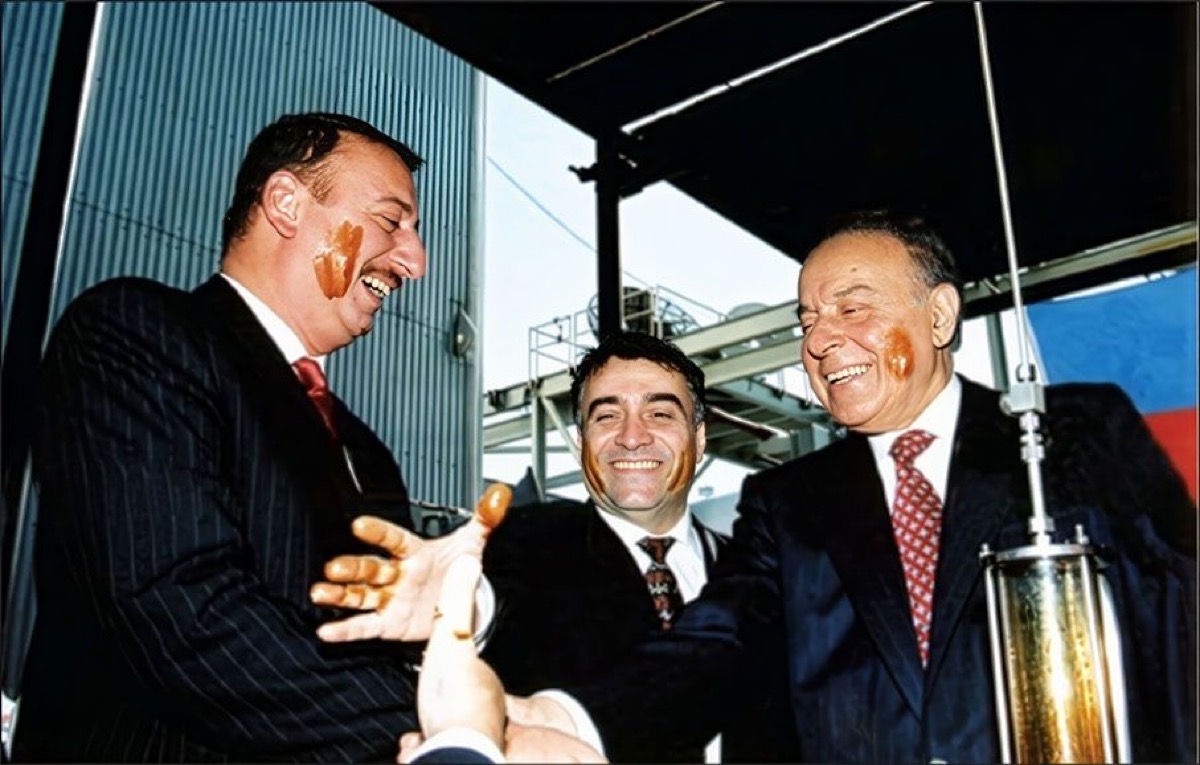
Oilmen’s day in Azerbaijan
02 February 2026
