



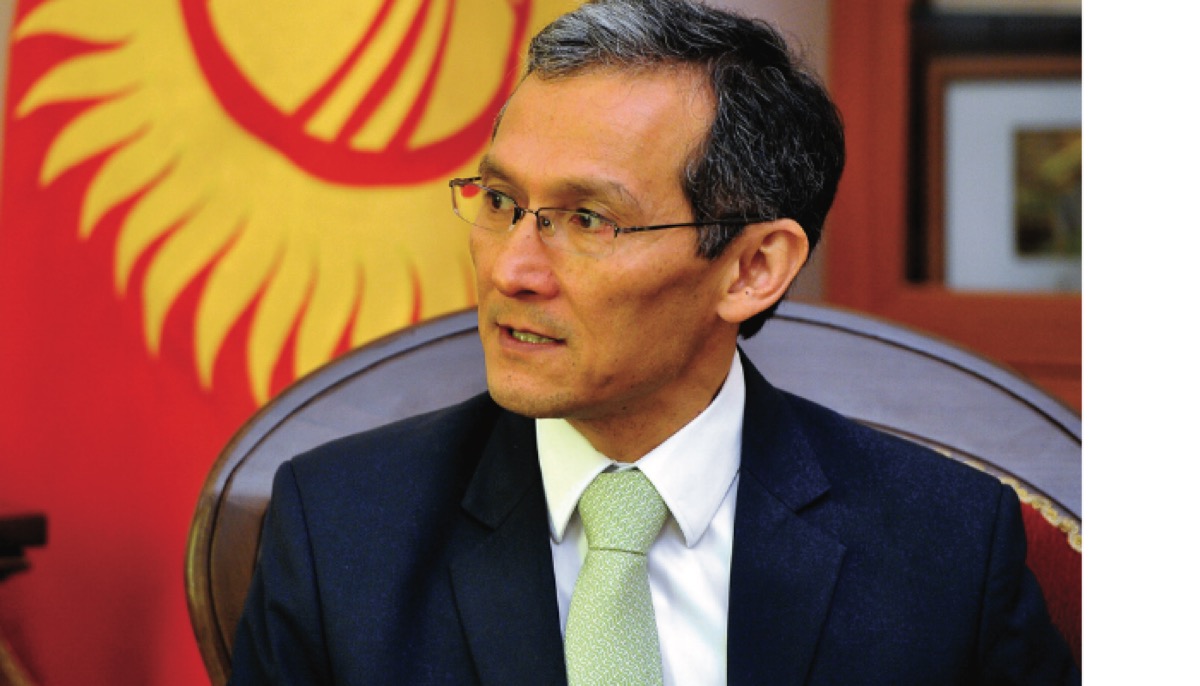
Caspian Energy (CE): Your Excellency, the Kyrgyz Republic enjoys the favourable geographical location in Central Asia. What economic and investment benefits does it bring to Kyrgyzstan?
Djoomart Otorbaev, Prime Minister of the Kyrgyz Republic: One of the apparent advantages of the Kyrgyz Republic is certainly its geographical location. Kyrgyzstan lies between the large markets of Russia, China and Kazakhstan. It is one of the main transit routes through the Central Asian corridor.
Kyrgyzstan builds mutual trust-based relations with the countries across the region, as well as with the non-CIS countries.
Over the last 10 years GDP of the country grew by 3.5 times. The financial crisis of 2009 along with the domestic political events directly affected growth indicators, but the national economy quickly recovered as proved by the 10.5 percent growth of GDP in 2013. The rate of inflation made 4%.
The Kyrgyz Republic also offers the advantage in terms of availability, quality and price of production factors. For example, labour cost favourably differs from the neighboring countries. The average salary in 2013 reached $220.
Certainly, one of the most perspective sectors for investment is the mining sector. Kyrgyzstan is rich with mineral resources, gold reserves and other rare-earth metals. For example, proven gold reserves make about 600 tonnes. Apart from gold, also available are mercury, antimony, tin and rare metals.
Among other competitive advantages of the country are the lowest tariffs for electricity among the CIS countries. The price of 1 kWh for industrial consumers is 1.5 cents per 1 kWh. In Kazakhstan and Uzbekistan this figure makes 3.5 cents, and 5.2 cents in Russia.
One of the perspective directions is the construction of hydroelectric power stations. The hydroelectric potential makes 142 billion kWh, and of this only 10% is currently used.
This potential enables to construct 33 more hydroelectric power stations in Kyrgyzstan.
The Kyrgyz Republic with its unique nature intends to take all measures for development of this very profit-making sector of economy.
In Kyrgyzstan there are lots of conservation areas, biosphere reserves and health resorts. The country enjoys the huge opportunities for organization of ecotourism, mountain hiking, alpinism, hunting and other types of active leisure.
The total planting acreage occupied with crops makes 1.2 million hectares. Its contribution to the economy is 17.5% of GDP.
All agricultural products are VAT-free. Agricultural production is ecologically clean and there is a huge potential for manufacture of organic products.
Besides, Kyrgyzstan located at the boundary between Asia and Europe takes advantage of the transit potential in the field of passenger/cargo transportation, including air traffic, which enables to implement the project on creation of an aviation hub on the basis of Manas International Airport – the node of air passenger/cargo traffic.
Now the Government of the Kyrgyz Republic carries out preliminary works on creation of an aviation hub.
The efforts on liberalization of the business environment and improvement of the investment climate were instrumental to boost a stable inflow of direct foreign investments. Today more than 40 countries are investors with a considerable share of investments.
The FDI inflow during 2014 made $965 million and ultimately approached 1 billion.
New reforms enabled to create the most liberal tax regime in the region. Rates of income tax, profits tax and VAT favourably differ from similar rates in Kazakhstan, Tajikistan, Uzbekistan and China.
In order to liberalise the business environment the Government of the Kyrgyz Republic carries out fundamental measures to remove administrative barriers and restrictions, improve the regulatory environment and liberalise external and internal trade regimes.
According to World Bank’s Doing Business report, the Kyrgyz Republic is ranked the 68th, having moved two positions up in comparison with 2013.
Only 2 procedures are required to start a business in the Kyrgyz Republic. It takes 3 days and relevant expenses make 2.7% of the average per capita income. These indicators place the republic to the 12th position worldwide.
Registration of property requires only 4 procedures, takes 6 days and expenditures amount to 0.3% of a project cost. These indicators place the republic to the 9th position worldwide.
Access to credits was improved by achieving flexibility of mortgage security of credits through mitigation of requirements in a credit contract for collateralized property. Under this criterion, today the Kyrgyz Republic holds a worthy 13th place.
To reduce a number of various administrative barriers and preconditions for corruption, the state apparatus was downsized by 20% and unreasonable interference of government bodies with the activity of business entities was terminated. The number of state services was reduced from 20,000 to 398 and the amount of licenses was lowered from 518 to 101. The “silence gives consent” principle, favourable to businessmen, has been introduced. Its effect is that if within 30 calendar days a licensing body does not give a license to an applicant party or does not notify on a refusal, an applicant party has the right to start that kind of activity in a month.
The Law “On Investments in the Kyrgyz Republic” envisages equal business environment for both Kyrgyz and foreign investors. Freedom of repatriation of capital, dividends and profit is guaranteed. There are no restrictions on conversion of revenues to foreign currency, including conversion for the purpose of further import or payment of future expenditures. Investors have the right to appeal to the International Court of Arbitration, bypassing interstate procedures.
Also, the Law on Public-Private Partnership was adopted. It enables private foreign capital to take part in infrastructure projects, using public-private partnership mechanisms. 10 such projects in the spheres of healthcare, transport and development of city infrastructure are being developed at the moment.
Please login or subscribe to read the full article.
Login / Subscribe