


Despite the negative developments in the markets due to oil prices plummeting to seven-year lows, the outgoing 2015 will be remembered as a year of great opportunities formed for national producers of the Silk Road Economic Belt partners - China-Kazakhstan-Azerbaijan-Georgia-Turkey-EU.
Eastern vector – China
The third container train consisting of 21 wagons and moving on the Trans-Caspian international transport route (China-Kazakhstan-Azerbaijan-Georgia-Turkey), which departed from the Chinese province of Lianyungang, arrived in Azerbaijan on December 11 and in Georgia on December 13.
The first test container train moving on the Shihezi (China)-Dostyk-Aktau-Alat route, arrived in the Baku International Sea Trade Port on August 3, 2015. The second container train consisting of 44 cars, which departed from the Alashankou export station of the Xinjiang-Uyghur Autonomous Region of the People’s Republic of China, moved through Azerbaijan and in 8 days reached the Tbilisi Central station in Georgia in late September. It is almost a two-fold cut in travel time unlike other routes.
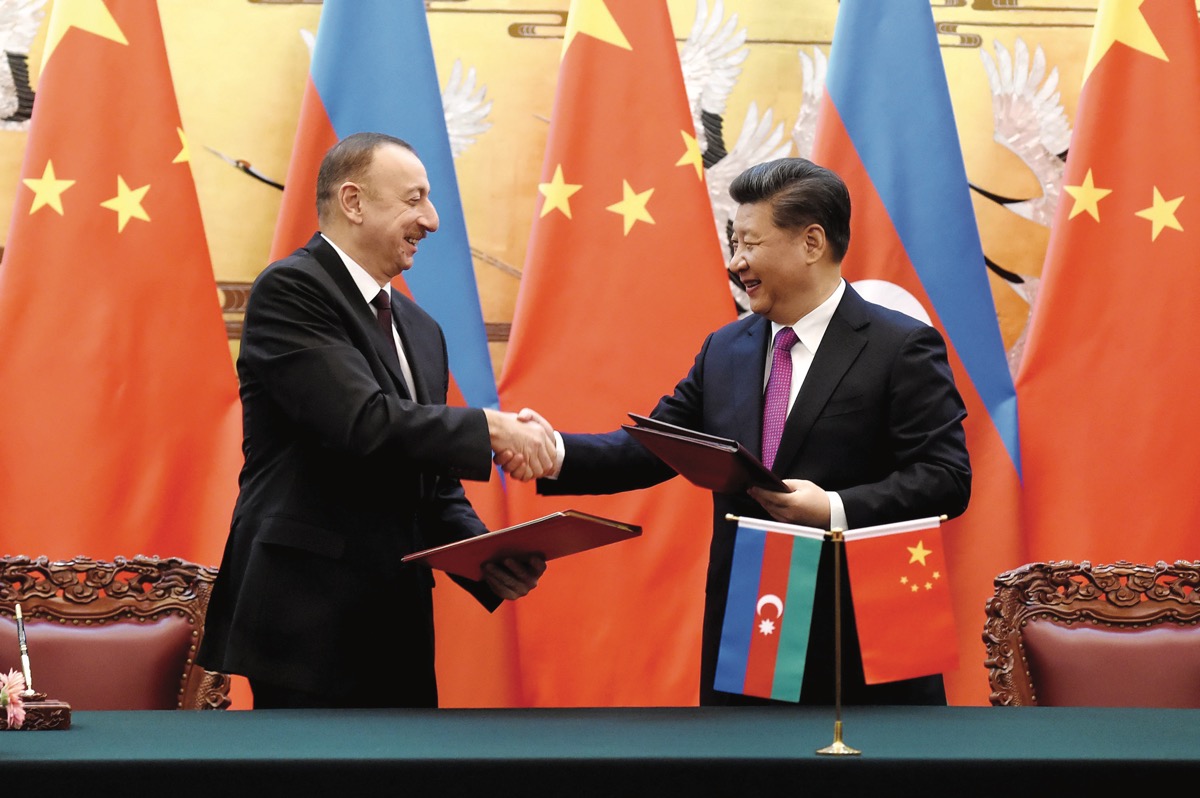
“There are good prospects for cooperation in the transport sector. We are fully supporting President Xi Jinping’s initiative to establish the Silk Road Economic Belt. The Azerbaijan’s geographical location makes our country a hub for transit of goods from Europe to Asia and from Asia to Europe. Currently, we are contributing investment to the modernization of the railways, construction of the largest port in the Caspian region and the railway connection between Azerbaijan and Europe, which I hope will become operational next year”, President Ilham Aliyev said at the meeting with President of China Xi Jinping on December 11. At the same time, once constructed, the Baku-Tbilisi-Kars railway will link Asia and Europe and put in place a missing rail link to create a historic Silk Road. This transport route will be the shortest way to deliver goods from China to Europe and from Europe to China, Ilham Aliyev stressed. The official visit of the President of Azerbaijan to China resulted in signing of 10 documents, and Azerbaijan also became a dialogue partner of the Shanghai Cooperation Organization.
The establishment of the SCO was announced on June 15, 2001. The SCO member countries are China, Russia, Kazakhstan, Kyrgyzstan, Tajikistan, Uzbekistan (together account for 16.1% of global GDP). Mongolia, Iran and Afghanistan enjoy the observer status holders. Dialogue partners are Belarus, Azerbaijan, Turkey and Sri Lanka.
In the summer 2015, China put forward the initiative to create a free trade zone within the framework of the SCO.
If summarized, the results of meetings enable to suggest that the 2016 year is going to be not only a year of commissioning of the Baku-Tbilisi-Kars international transport railway connection, but also a year of inflowing strategic Chinese investment to Azerbaijan. “We are hopeful to see more Chinese companies operating in our country, especially in the field of industrial production, information technologies, high techs, agriculture and many other areas. With the close and friendly relations between our countries taken as a basis, we should add a very important economic component to them”, said President Ilham Aliyev.
In turn, Xi Jinping expressed his willingness “to strengthen working ties in order to maintain a constant high growth in the development of the bilateral relations”. Xi Jinping stressed his support to Azerbaijan’s activities in the project for creating of the Silk Road Economic Belt. According to him, Azerbaijan has good possibilities in the logistics system and international transport, and in this regard could play an important transit role between China and Europe. The Chinese President stressed the importance of cooperation with the Asian Infrastructure Investment Bank, as well as the possibility of expanding relations in the field of transport and manufacturing industry.
The Asian Infrastructure Investment Bank was created in 2014 upon the initiative of China. In October 2014, 21 countries signed the agreement to establish the AIIB. The bank with a focus on financing of infrastructure projects in the Asia-Pacific region will be headquartered in Beijing. The equity capital will be $100bn. To date, the bank brings together 57 member countries. In late June, the representatives of 50 countries signed the Articles in Beijing. China, India and Russia are the largest members of the financial institution. It is expected that the AIIB would be operational by the end of December 2015.
Western vector – China
Taking into consideration that in early October Azerbaijan was invited to take advantage of the infrastructure of the Panama Canal (at the meeting of Azerbaijan Foreign Minister Elmar Mammadyarov with acting Minister of Commerce and Industry of Panama Nestor Gonzales) and on October 5 the United States and 11 other Pacific Rim nations reached an agreement to establish the Trans-Pacific Partnership (TPP), one can suggest a more global continuation of the Trans-Caspian international transport route. It is commonly known that Panama is a leading country in Central and South America in terms of economic growth, and the Panama Canal generates the bulk of the country’s income. The Panama Canal, in turn, had an incredible impact on economic development in the West and around the world, which predefined its extremely high geopolitical importance.
It is known that the TPP deal’s ambition is to create a free trade zone in the Asia-Pacific region with the participation of 12 countries: Australia, Brunei, Vietnam, Canada, Malaysia, Mexico, New Zealand, Peru, Singapore, the US, Chile and Japan. The deal is expected to cover about 40% of world trade. The countries, which together account for more than a third of global GDP, establish a free trade zone with zero duties, consolidate the rules for intellectual property turnover and control on export, and perhaps an agreement on monetary policy.
With the start-up of the Baku-Tbilisi-Kars railway link in 2016 the Silk Road Economic Belt will get even greater incentive to enhance a turnover.
At the same time the United States and the EU have a similar project on the agenda, namely the Transatlantic Trade and Investment Partnership (TTIP). As you know, in late October the sides held another round of talks to establish a free trade zone between the US and the EU. The US is likely to contribute all its efforts to foster the TTIP deal and sign an agreement before the term of office of incumbent President Barack Obama expires in the end of 2016. This is despite the fact that the TTIP ‘took a back seat’ in terms of timing due to the situation with migrants. However, if combined in the future, the global opportunities of TPP and TTIP would enable to speak about new conditions of international trade. Taken together, these two areas will account for 86% of world GDP. So, Azerbaijan producers along with the transit partners of Azerbaijan and Turkey will not only benefit from new emerging opportunities of an open global market, but also become one of its central parts.
