



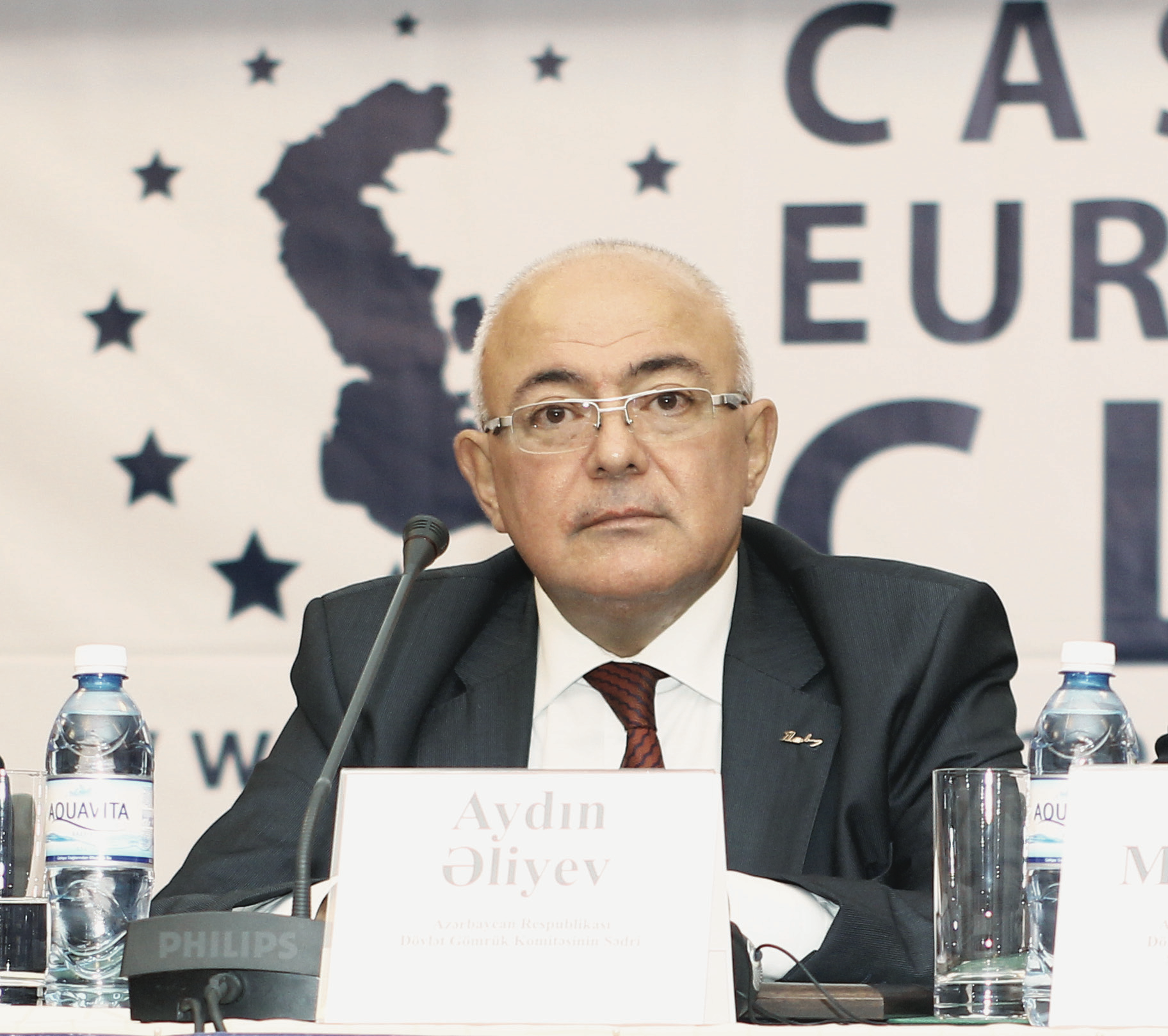
Caspian Energy (CE): Mr. Aliyev, one of the leading global trends today is creation of the free trade zones, withdrawal of customs barriers as well as free transit of international cargoes. Which measures is the State Customs Committee of Azerbaijan currently undertaking in this direction?
Lieutenant General Aydin Aliyev, Chairman of the State Customs Committee of Azerbaijan: Nowadays, one of the priority missions of the customs bodies is to ensure transit of commodities and transport vehicles via the territory of our country which enjoys a favourable location indeed. All necessary measures are taken to develop our resources in this area.
The issue of regulation of the international transit in the customs context is under urgent attention of international agencies and organizations. European Economic Commission and the United Nations have relevant conventions and resolutions for regulation of the international transit. Azerbaijan, as a member of these organizations, actively participates in all plenary sessions and meetings held on quarterly and annual basis.
Introduction of the book about International Cargo Transportation can be brought as an example. The work on creation of the “Green Corridor” system is carried out in order to ensure transparent and flexible customs registration for freights and transport facilities, development of citizen-official relations on basis of modern management principles. According to this system, transportation of cargoes via the customs borders will be carried out on basis of electronic import declarations prepared beforehand and submitted to the customs bodies.
By developing a transport corridor crossing the territory of Azerbaijan, the Customs Bodies are strongly contributing to the development of the transit potential of our country.
The work on simplification of the customs border passage, creation and development of the appropriate border infrastructure is also ongoing.
Issues on liberalization of import and export operations in Azerbaijan, maximum use of the transit potential and facilitation of the customs procedures of the country are always in the center of attention of the head of state. As an example, noteworthy is President Ilham Aliyev’s Decree (dated October 21, 2015) about creation of the Coordinating Council of the Republic of Azerbaijan for transit cargo transportation.
This Decree will lead to important changes in the mentioned area such as enhancement of cargo transportation quality, establishment of relations between the structures engaged in this area, optimization of time of cargo delivery and transportation costs, growth of competitiveness of transit corridors passing through our country and finally possibility of gaining big profits by the country from transit cargo transportation.
Broad measures have been taken for a fruitful management of the customs service’s activity which is aimed at the growth of the transport potential.
Infrastructure capacities and material-technical base of the crossing points on the customs border, located at the intersection of major corridors and passing the territory of the country, have been extended in order to modernize the customs infrastructure in accordance with international standards.
6 customs-border points of the country were fully upgraded and commissioned after they had been equipped with modern facilities of technical control. Customs bodies carry out customs control, registration of cargoes and transport facilities according to the “single window” principle. Broad opportunities have been provided for it.
Necessary conditions for performance of customs procedures and operations have been created at the area of the new Baku international trade port which plays very important role in strengthening the transit potential of the country. Certain work on provision of the most advanced technical control facilities has been carried out at the area of the Port in order to ensure fruitful and qualitative conduction of the customs control.
Alongside with this, new projects are introduced to strengthen the transit potential. Operations have been carried on basis of the project, developed jointly with the European Union, in order to create new customs infrastructure unit on customs points located along the historical “Silk Way” corridor. As performance of cargo operations with goods is of paramount importance in terms of the speed of turnover of goods and transport facilities, development of the customs infrastructure in this direction is one of the priority tasks. It is planned to start construction of new customs terminals, warehouses and other infrastructure units, along with their fitting with the most modern equipment, within the framework of the above mentioned projects.
CE: Which measures are undertaken to simplify customs procedures?
Aydin Aliyev: The number of documents, which are to be submitted in the course of the customs control, has been considerably reduced so that to raise rationality of customs control. Conditions have been created to provide preliminary brief electronic declarations on import and export, which helps to analyze risks of declared goods and transport vehicles, transported across the customs border, and carry out customs control on a selective basis.
Introduction of information technologies is increasing. The number of services lent by the State Customs Committee through the portal of the e-government and internet page of the State Customs Committee of the Republic of Azerbaijan is constantly increasing. All this work is done to facilitate customs control, ensure transparency and minimize the contact between citizens and employees of the customs committee.
Providing transparency in customs registration and facilitation of the declaring process is one of the important projects realized within the framework of the customs-to-business cooperation. Possibility of introduction of the new declaring system is created for it. That is to say, now it will be possible to declare goods and transport facilities via internet, avoiding certain work. This system envisages submission of customs declarations and other goods-related documents to the customs bodies online upon the availability of the e-signature. Pilot project within the framework of the customs representation institute has been introduced since April 4 of this year. Full scale implementation started in May 2016.
Due to the introduction of the Unified Automated Control System (UACS) of tax bodies in the Republic of Azerbaijan, more flexible and well-organized customs control and registration has been introduced in all the crossing points of the customs control so that to organize customs control in accordance with the modern requirements. This system, developed within the framework of the initiative for modernization of customs bodies, provides control of different business-processes in the customs sphere. UACS, combining different modes of management, makes it possible to conduct an integrated control of operations of state bodies, foreign participants engaged in the economic activity, transporters and others from the single center. A project on Time Release Study has been developed in the crossing points of the customs border of the Republic of Azerbaijan by using a strategy entrenched by the World Customs Organization’s “Instruction on Time for customs clearance”. Project software has been prepared, including integration into UACS.
Introduction of this project helps to determine the time of border crossing by commodities. Conditions for more qualitative management over crossing of commodities and transport facilities across the border are created on basis of the analysis of collected statistical information.
According to the recognized technological scheme on introduction of the single window principle, UACS –RISK system is applied when registering and checking goods and transport facilities which should cross the customs border points. It helps to automate risk management during the check-up of goods and transport vehicles.
Based on the risk management methods, risk analysis is carried out in the automated regime in order to determine the degree of check-up of commodities and transport means crossing the customs border points.
Protocols on arranging primary information exchange have been signed between the State Customs Committee of the Republic of Azerbaijan, State Customs Committee of the Republic of Uzbekistan and Georgia Department of Revenue in order to obtain early information about goods and transport means crossing the customs border points. Besides, protocols on information exchange have been signed to implement the similar projects with the Republic of Turkey, the Islamic Republic of Iran, the Russian Federation, Kazakhstan and Ukraine. Drafts of technical documents have been agreed.
In general, customs bodies have been making a sustainable contribution to the growth of the transit potential of the country by developing transport corridors crossing Azerbaijan.
CE: To what extent has been the work of the State Customs Committee of Azerbaijan optimized in compliance with international regulations and rules?
Aydin Aliyev: The new Customs Code of Azerbaijan has been developed in conformity with the requirements of the international convention “About simplification and agreeing of customs procedures” of the World Customs Organization, requirements of the protocol about the change of this Convention and improved customs code of the EU. Alongside with this, tasks arising from the World Customs Organization’s “Framework standards on simplification and safety of the international trade” are also reflected in the customs legislation. A new institute started operating in order to ensure fast and effective crossing of goods and transport facilities via the customs control and registration. It is an institute of the authorized economic operator. A legal framework has been developed for its proper operation as well.
New rules and forms of declarations required during the crossing of commodities and transport facilities via the customs border have been brought to full compliance with requirements of the improved customs code of the EU. Procedures and operations in the field of import-export have been considerably facilitated and simplified.
CE: What work is carried out to settle customs control problems arising on borders of the country during the flow of tourists?
Aydin Aliyev: A big scope of work has been done to attract tourists into our country. Procedures of submission of declarations for goods, transported via the customs border of our country, to the bodies by physical entities, have been simplified. Users enjoy an electronic service “Simplified declaration for physical entities” which has been integrated into the portal of the e-government. Thanks to this service, prior to the arrival at the customs point, physical entities have an opportunity to fill online declaration of goods which are to be transported via the customs border. 76, 863 users applied this electronic service in 2015.
CE: Which innovations will State Customs Committee introduce after Azerbaijan becomes a member of the world trade organization (WTO)?
Aydin Aliyev: As is known, Azerbaijan applied for the membership in the WTO as early as June 23, 1997. After this application, a working group on Azerbaijan was created on July 16, 1997. The working group has held 12 sessions over the past period.
As a result of bilateral negotiations, 5 states (Turkey, Oman, the UAE, Georgia and Kazakhstan) signed joint protocols of consent.
Bilateral negotiations are currently held with 21 states in the field of goods and services. Thus, active negotiations on goods and services are held with such states as the USA, EU, Japan, Canada, Norway, India, Taiwan province of China, Korea and the Russian Federation; negotiations on commodities only are held with the following states: Sweden, Sri Lanka, Ecuador, Brazil, Honduras, Malaysia, Dominican Republic; negotiations on services are held with Saudi Arabia. Apart from this, notes for conduction of discussions have been sent to Indonesia (on goods), Paraguay - oral address, to China and Vietnam on recognizing the country as a market economy.
It is noteworthy that a mandatory fulfillment of a series of obligations, envisaged in WTO agreements, is required from Azerbaijan due to multilateral negotiations:
- Conformity of excise duties (the process of making appropriate changes into the national legislation has been commenced due to this matter);
- Removal of export bans, maintenance of export duties on existing level;
- Refusal to introduce export subsidies in the agriculture;
- Refusal of introduction of subsidies, prohibited in industry, etc.
The following conditions are put forward to the Azerbaijani side in bilateral negotiations:
- Application of “bound” tariff (maximal limit of export tariff rate after getting a membership) and its further considerable reduction on goods - except for a number of sensitive goods which are of particular importance for Azerbaijan;
- in regard to other agricultural products – to reduce export duties down to “zero” or lower them to a minimum in accordance with the sectoral agreement by joining sectoral initiatives (agreements).
For information I would like to note that until now Azerbaijan has consented to participate in 4 secotral initiatives after becoming a WTO member and a minimum 4-year transition period – information technologies, medical and scientific equipment and the agreement on chemical harmonization.
CE: Does the State Customs Committee plan to introduce a differentiated scale on import of products both produced and not produced in Azerbaijan? Is the possibility of zeroing duties for a raw material, a major component of the local production, considered?
Aydin Aliyev: Relevant activities are currently carried out in order to shift from the multistage tariff system into a few-stage tariff system of the customs duty applied on goods which are imported to the Republic of Azerbaijan. Domestic market and interests of local product producers are protected in order to ensure an economic security of the country. A more effective protection from the impact of the negative foreign competition is set.
Relevant central management bodies provide conditions for shifting to the few-stage system through lowering the multistage system’s customs for product import. It is done in order to ensure rights and interests of producers. It is generally known, that the rate of customs duty for goods imported to the Republic of Azerbaijan is regulated by the Cabinet of Ministers’ Decree (dated December 22, 2003) #161 “On introduction of amendments into the Decree “On rates of customs duty for export-import operations in the Republic of Azerbaijan” dated April 12, 2001 #80. Based on this document, a 0.5% customs duty is imposed on major amount of raw material used in production of an end product.
Alongside with this, the necessity to ensure flow of profits into the state budget at the expense of revenues, gained from the non-oil sector, provision of abundance of national products at the consumer market and increase of activity of business in the real sector of economy, constantly arises amid the global financial-economic processes running in the world.
According to the Law of the Republic of Azerbaijan on introduction of amendments into the Law of the Republic of Azerbaijan “On customs tariffs”, approved by the head of state of Azerbaijan, private entrepreneurs, who received investment stimulation documents, are freed from paying customs duties in 7 years since the moment of reception of the investment stimulation document in line with the rules of the relevant body of power and approved documents.
The necessity to improve customs tariffs, mechanism of development of customs tariffs for imported products and removal of unnecessary tariff discounts, arose in current conditions in order to develop and expand production sites, increase production of end products and provide favourable conditions for accessing foreign markets. Recommendations on the items of goods together with an indication of specific areas and the period of application of privileges for different categories of goods have been submitted to the Cabinet of Ministers of the Republic of Azerbaijan. Corresponding work is underway to create working groups for joint discussion of proposals with the relevant agencies. Agreed single proposals will soon be submitted to the Cabinet of Ministers of the Republic of Azerbaijan for consideration.
Thank you for the interview
