



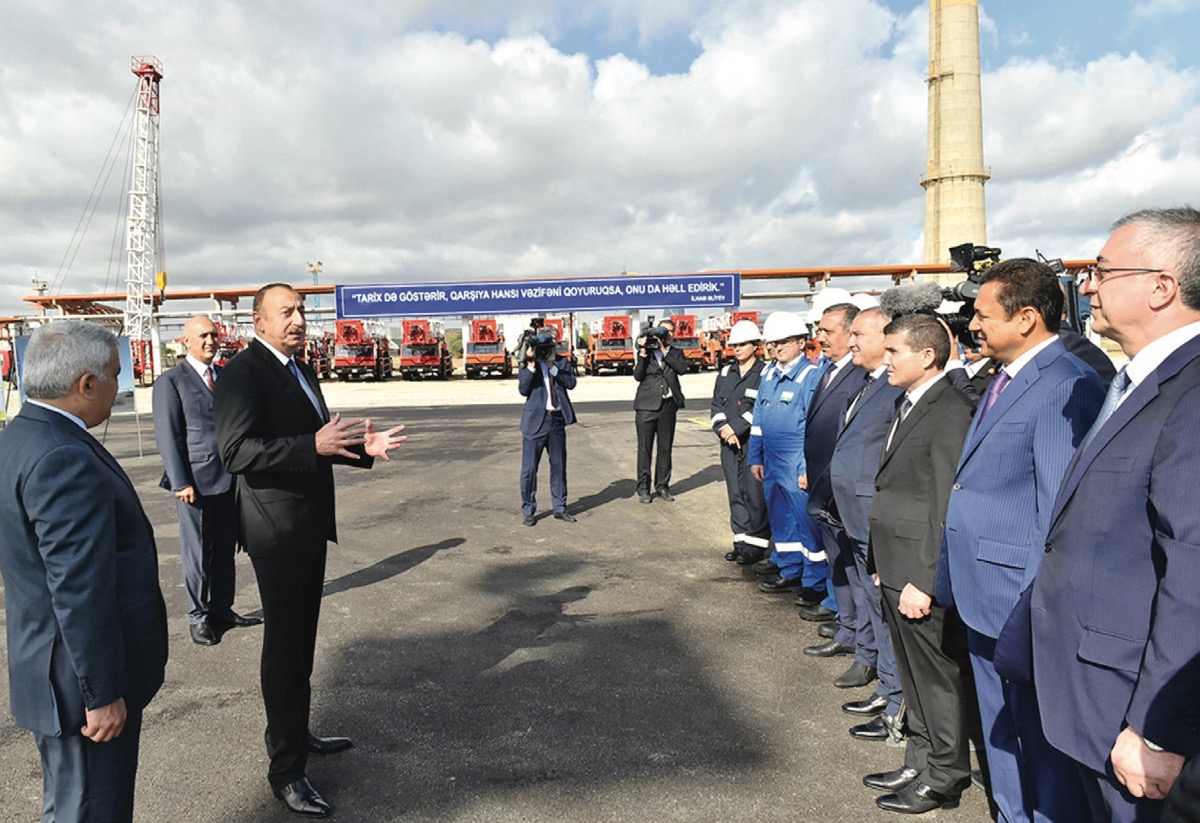
e capacity of the new bitumen production unit to be constructed at the Heydar Aliyev Oil Refinery will total 400,000 tonnes per year. Road bitumen EN 40/60 will be produced at this unit, which is to be commissioned in mid 2018. Construction of the new bitumen production unit will be the first step of the reconstruction activities. According to this program, diesel fuel meeting Euro-5 standard is planned to be produced at the Heydar Aliyev Oil Refinery in 2019. Euro-5 gasoline production is scheduled for 2020. Once implemented, the project will enable to increase the Heydar Aliyev Refinery’s capacity to 7.5 million tones. As a result, the domestic demand for motor gasoline will be covered during the following 15-20 years, and the export of high-quality oil products will increase as well.
Caspian Energy (CE): Mr. Ismayilov, what could you tell about the results on renovation of units? What stage have they reached? What objectives did the Refinery’s personnel have to achieve in August during the repair of the existing production units at the Heydar Aliyev Oil Refinery?
Elman Ismayilov, Director of SOCAR Heydar Aliyev Oil Refinery: Reconstruction and modernisation of the Heydar Aliyev Oil Refinery have been started according to the instructions of President Ilham Aliyev in order to meet the compliance of petrol and diesel fuel with the Euro-5 environmental standards, to manufacture oil products competitive on both domestic and foreign markets, to meet the demand for petroleum products in the domestic market until 2030. The range of works for reconstruction of the existing facilities and construction of new ones has been currently defined. First and foremost, as you know, after modernisation the current capacity of the crude oil distillation unit ELOU-AVT is to increase from 6 to 7.5 million tonnes per year, and the capacity of the fluid catalytic cracking unit (FCC) from the existing 2 to 2.5 million tonnes per year.
Reconstruction and modernisation of the core process equipment, and large-scale repair has been implemented at our Refinery since August 1 this year with the aim to achieve the set objectives. The distinctive feature of the current repair work is that in connection with modernisation at the Refinery the equipment and facilities should be prepared for repair in an individual way. It was necessary in order to carry out non-destructive (NDT test) tests to assess the technical condition of the operational capabilities of the major operating units of the process facilities in the post-modernisation period. This, in turn, dictated to carry out additional work on the preparation of units and equipment.
The crude oil distillation unit #21 was halted for overhaul repair on August 5 and the following works have been performed over this period: replacement of defective bends on the serpentine pipeline of heater S-1/1, the output lines of heaters S-1/2, 3, serpentine pipelines inside the heater S -1/3, and repair of the out-of-run refractory lining of the S-3 heaters. Defects inside the vacuum column were eliminated, and the purchased IV package was installed. Defective out-of-work sections on the III package were removed and I and II packages were completely replaced.
The set of exchanger piping ID-4/2 was fully replaced at the unit, and the bundles ID-7/1, 3 were installed after the flushing. The defective pump N-3/1 was replaced together with the engine, pumps N-3/3 and N-7/1 underwent inspection. The fuel line leading from T-6 to N-16/1, 2 was substituted, and some work was performed on the steam pipe. The overhead line of the K-2, K-8 columns and defective plates of the K-1, 2 columns were also replaced. All flow meters were installed after cleaning and inspection, the operations on revision of transformers, pumps and substations were carried out.
CE: Could you please tell about works executed at the other main units of the Refinery?
Elman Ismayilov: The catalytic reforming unit (CRU) N-31 was halted for repairs on 11 August 2016. During the repair work some part of the catalyst was released from the reactor DR-111, which is very important for the Refinery’s efficient operation, and the reactor was partially filled with a new cobalt-molybdenum catalyst.
The spent and life-expired catalysts with the platinum composition inside the DR-211-214 reactors were removed after regeneration, and the process of filling the reactors with a new catalyst was completed.
At the same time, some important works were performed at the CRU’s heat exchangers: the inside parts of the heat exchangers ET-212 and 213 were switched off and cleaned, the bundles inside ET-221 were replaced with new ones, the heat exchangers ET-214, 215, 216 were disabled and cleaned. The heat exchanger ET-111/1, 5 was remounted at the unit after the pressure tests.
The out-of-run valves of the GP-512 pumps were replaced. Water tanks DK-554, 555 and tanks E-1, DB-111 and DB-821 were cleaned after shutdown and then recommissioned. The repair work on the BH-111, 121, 221 heaters were ended, the set of pipelines was cleaned. The BH-211-214 furnaces underwent repair works. The repairs of the GC-111 A/B, GC-211, GC-212 A/B compressors were completed. It stands to mention that a brand-new automatic control system was installed and adjusted at the process control unit. The extensive renovation at all units is being executed by the SOCAR-run Oil and Gas Construction Trust, teams for different purpose of the Repair and Assembly Section #13, the involved locksmith’s teams from the different production sites of the Refinery. The workers from the overhaul, mechanics, energy and metrology departments do not spare their forces for the timely implementation of the repair work.
Daily staff meetings are held involving the executive team and senior specialists to avoid downtime and ensure a timely and high-quality execution of the planned maintenance work. The focus is on the supply-related matters and other important tasks. All this testifies to the fact that all the tasks set we intend to successfully implement.
Further important phase of the work was to commission processing units after the major overhaul, we successfully completed it.
CE: What about modernisation of the flare facilities?
Elman Ismayilov: I would like to note that there was still more work to do. The repair work was also performed at the delayed coker unit #№43 and flare facilities according to the technical requirements and in line with the approved schedule on elimination of defects.
As for the flare facilities, flame arresters of the M-3 flare stack were reinstalled after their inspection and repair. The out-of-run 500 mm pipeline from the T-1 tank to the flare tower was replaced by a new one. The difficulty of this work was that we had to completely shut down the in-service process units during the replacement process. The broken DN-500 mm valves on the inlet lines of the tanks T-1 and T-2 and within the flare towers were replaced with new ones.
One of the most important and difficult tasks was to replace the two pairs of the old cyclone groups on the R-202 regenerator at the unit #55, which were substituted with new ones during the repair work. The life-expired distribution branch lines at the R-202 air distribution manifolds were also replaced with new ones. Moreover, the out-of-run life-expired concrete refractory lining and armored grid inside R-202 were replaced with new ones, the covers of cyclonic groups of the R-201 reactor, the broken refractor lining and armored grids were repaired, the control valves 2-104 and 2-181 underwent major overhaul at the catalyst transfer lines.
The out-of-order trays and equipment inside the distillation column K-201 were overhauled as well. The operating sets of air devices and water-cooling lines were also cleaned and prepared for further usage.
The works performed on the existing air and water coolers in the box 300 deserve special attention. The high-quality repair was executed on the K-304, T-304, ID-317/1,2, K-306, T-306, ID-314, K-303/1,2, ID-312 and T-307 devices. The old sets of pipelines on the air cooler HS-307 were replaced with new ones, and the pipelines of the inlet and outlet collectors were renovated. Similar work was also performed on the air cooler HS-306.
In view of the expired service life of the catalyst in the hydro-treatment compartment the reactors R-101/1,2 were completely released from the spent catalyst, and special distribution networks of Equiflow tray type were installed in both reactors under control of the Axens specialists. The new catalyst proposed by the company will boost a growth of high-quality indicators of diesel fuel Euro-4, Euro-5.
CE: Could you please tell about the main outcomes of the economic activity of the Refinery since the beginning of the current year?
Elman Ismayilov: Currently, all operating procedures of the FCC unit, the delayed coking unit and other sections of the Refinery have been computerised. The workshops and production sites were overhauled and all the necessary conditions were created for employees. All safety standards, product quality and environmental requirements at the Refinery meet the standards.
In January-July 2016 the executive personnel and employees of the Refinery progressed notably on the implementation of production tasks and instructions of SOCAR. Thanks to the maximum use of the human resources and technical capacity we have succeeded in the implementation of the production program.
Over the period under review the Refinery processed 3,733.7 thousand tonnes of feedstock, of which 3,733.7 thousand tonnes of oil and 37.5 thousand tonnes of semi-finished products.
The rational use of production capacities of all process units, especially the processes of reprocessing the heavy and light feeds, was put in place at the Refinery thanks to the oil refiners, and the conditions were created for production of more expensive oil products from the existing resources of residual components of lower value produced after processing. For the period under review we have brought the processing depth to 87.5%, 0.9% up the plan figure.
In January-July 2016 the Refinery produced 680.8 thousand tonnes of motor gasoline, 1506.2 thousand tonnes of jet and diesel fuel, 103.1 thousand tonnes of liquid gas, 113.8 thousand tonnes of petroleum coke, 85, 3 thousand tonnes of oil bitumen, 49.7 thousand tonnes of DT and A motor fuels, 5,2 thousand tonnes of lubricating oils of different brands. For the chemical industry the Refinery produced 98.9 thousand tonnes of hydrotreated gasoline, 39.1 thousand tonnes of sweet gas. 350.1 thousand tonnes of fuel oil and other petroleum products were produced for Azerenerji and other organizations. In general, for the period under review the Refinery produced commodities worth 1,008.3 million AZN. 27% of the produced commodities went for export.
