



Corporisation of the state property has become a particularly relevant matter after President of Azerbaijan Ilham Aliyev issued the decrees on economic reforms. Nowadays it is perhaps the key issue. It is a core of reforming the entire structure of the Azerbaijan’s economy in the direction of a competitive, technological, efficient, and open market. President Ilham Aliyev has many times mentioned this point in his speeches and further practical enactments.
In July 2016, President of Azerbaijan Ilham Aliyev signed the decree on measures to improve the management efficiency and speed up privatisation of the state property. Under the decree, speed up of privatization of the state-owned property is defined as the important area of the economic policy. The decree specifically stated that in the process of setting priorities for privatisation of the state-owned property the first priority is given to privatisation of non-performing businesses with a competitive potential in the region, which are capable to make a notable contribution to the socio-economic development. In order to boost the work carried out in this area, to ensure a more efficient use of state-owned property and to improve the state property management the Cabinet of Ministers was charged with the task to use the proposals of the State Committee for Property Affairs and other government agencies as a basis and in the medium term draw up a list of state-owned enterprises, which will remain a state property, carry out their restructuring, undertake measures to privatize non-core entities and facilities thereby release them from subordination.
In September President’s economic advisor Natig Amirov stated that there is a positive approach in Azerbaijan towards the release of shares of public companies for circulation. He made this statement at the ceremony dedicated to presentation of SOCAR bonds.
“There are requirements for corporate management, transparency, accounting which are necessary for issue of shares. Nowadays SOCAR meets these requirements and is ready for issue of shares”, N.Amirov noted.
Chairman of the Board of Directors of the Chamber for the Financial Market Supervision Rufat Aslanly expressed hope that SOCAR would be a pioneer in the stock market just like the way it does at the market of securities.
At the same time, SOCAR President Rovnag Abdullayev noted that SOCAR, as a state company, does not intend to carry out mass placement of shares. As Azerbaijani Media reported, no massive placement of shares is expected if SOCAR issues them in future.
In his interview with SOCAR plus journal Vice President of SOCAR for Personnel, Regime and Information Technologies and Editor-in-Chief of the same name journal Khalig Mammadov said: “Engaged in many big projects, SOCAR must be capable of competing with well-known oil companies worldwide. We should play by the same rules for this. These rules imply international standards for technologies, ecology, human resources management and other areas».
SOCAR for the first time placed bonds in the domestic market in September of this year. On September 6 the Chamber for Financial Market Supervision of Azerbaijan registered the prospect of issue of bonds denominated in the US dollars. The bonds were put on sale on September 20, which shall last till October 10.
The total volume of issue makes $100mln. Issue has been split into 100,000 bonds each worth $1.000.
The circulation period is 5 years. Bond yield is 5% per annum. Interests will be paid once in 3 months. No tax imposed on interest yields.
The Company has placed three issues of Eurobonds at foreign markets – bonds worth $500 mln in February 2012 for a term of 5 years, bonds worth $1bln in March of 2013 for a term of 10 years and bonds worth $750 mln in March of 2015 for a term of 15 years.
oil upstream
Now let’s dwell on the situation in the oil upstream of the country, which has been a source of the current economic achievements of Azerbaijan since the signing of the historical Contract of the Century under the leadership of the National Leader of Azerbaijan Heydar Aliyev.
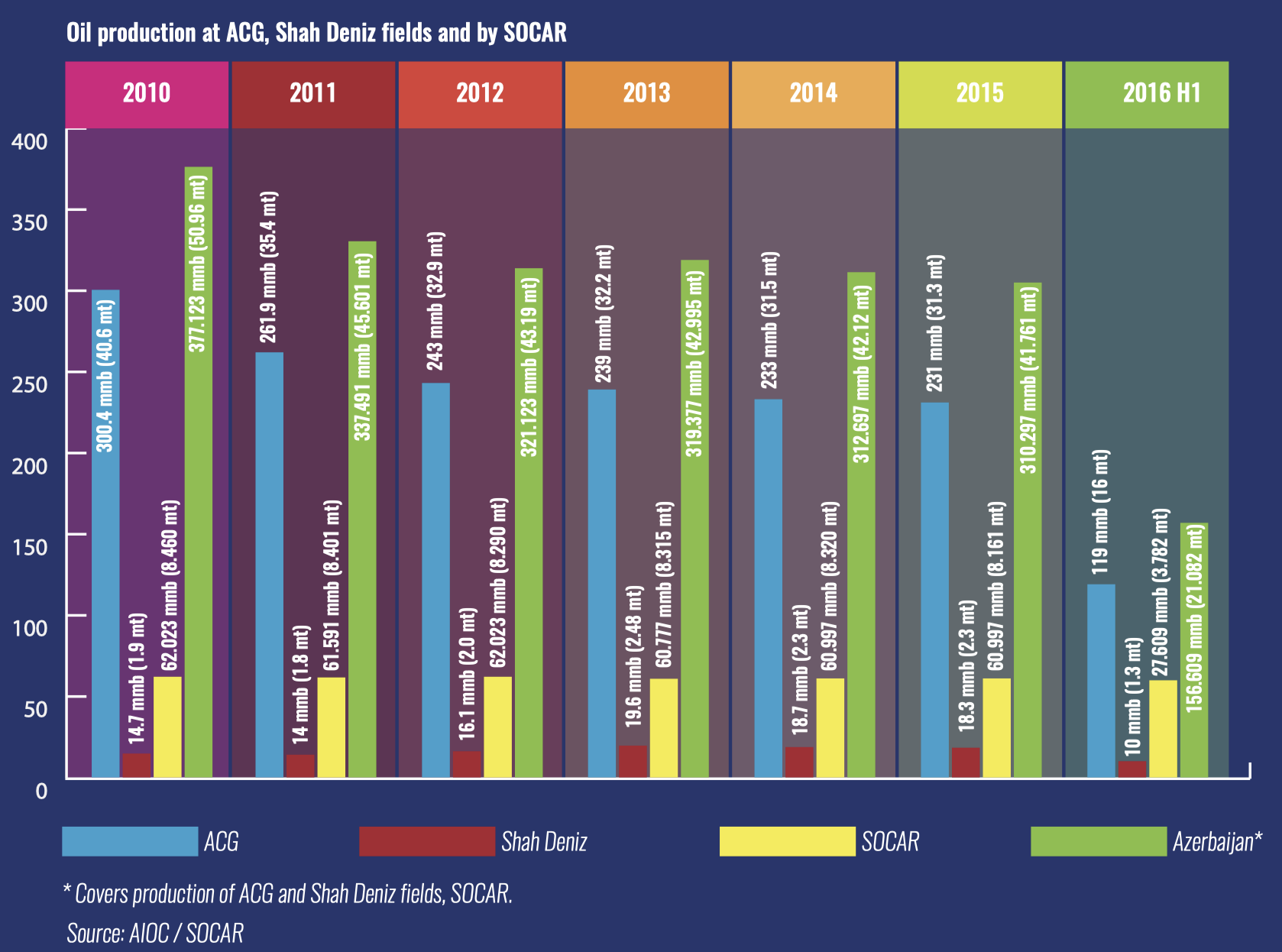
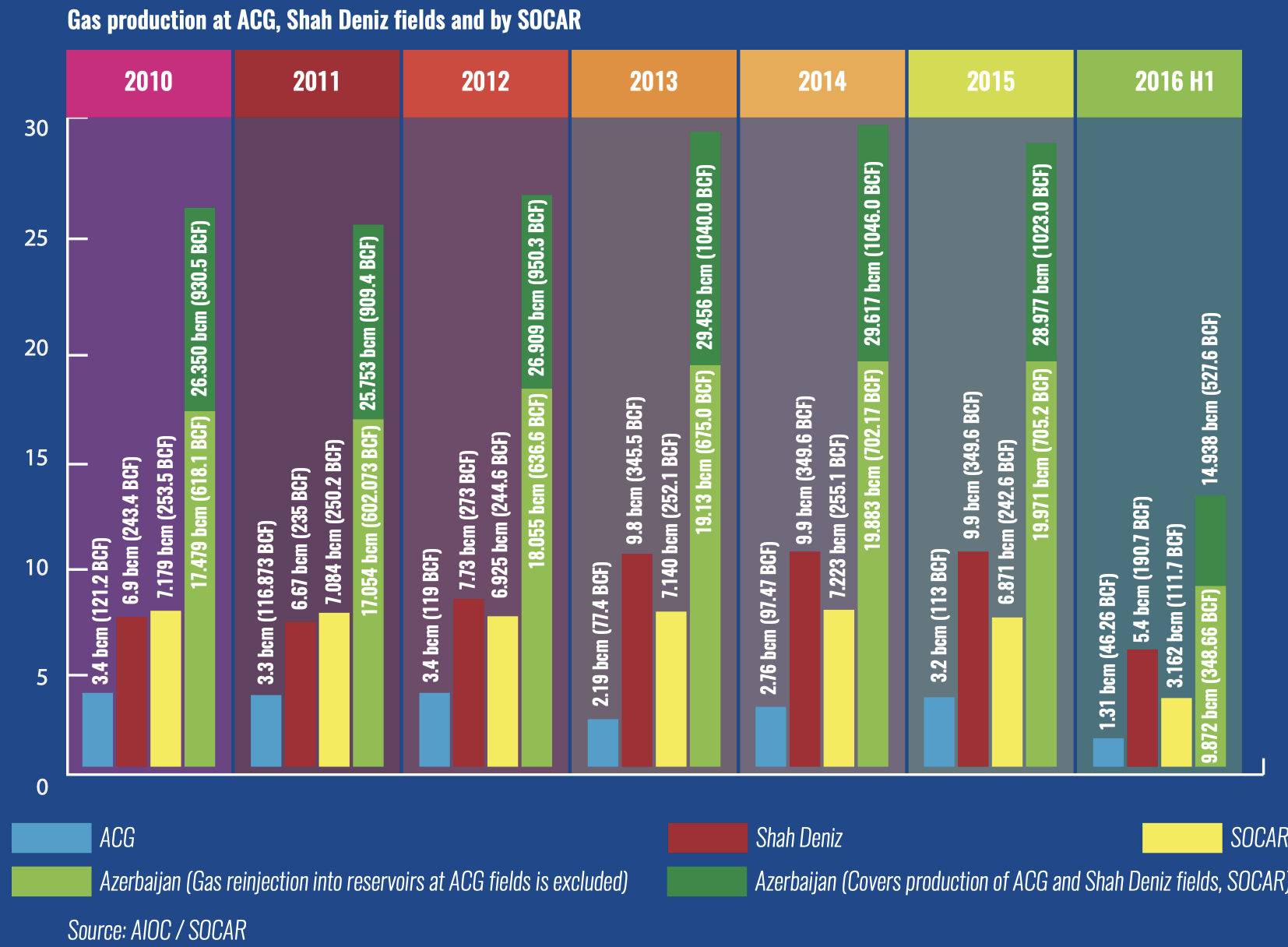
Unfortunately, considering the current situation, everything that Azerbaijan can anticipate from its strategic industry is only a natural oil production decline, that is to say, its maintenance through injection of gas volumes similar to the annual amount of gas produced by SOCAR (see the info graphic on pages 23-24). There are following factors causing it.
Firstly, the condition of oil assets in the country, such as reproduction of reserves, oil production cost, recovery rate, leaves much to be desired.
Their further decline will imply pressure on market value of the state company, which is inadequate for the present international activity of the company in other sectors of the oil-gas industry due to the unfavorable situation with prices at the global markets.
As of January 1, 2015, proven oil reserves of SOCAR totaled 72 ml. 053 thou tons while this figure totaled 78 ml. 502 thou tons a year earlier. That is to say, decline of reserves made 8.2% within a year, says the report on SOCAR’s sustainable development following the results of 2014, published at the website of the State Oil Company. In 2015 the Company managed to compensate the decline of reserves reproduction (as of January 1, 2016, 74 ml. 336 thou tons) approx by 2% owing to the discovery of the gas condensate field Umid. The similar decline of company’s reserves is forecasted in 2016 due to the lack of new discoveries in the Azeri sector of the Caspian Sea. In this way, for the last three year period SOCAR’s losses in assets will make about 13%.
Production cost of 1 ton of oil totaled 91.63 AZN ( about $116.57 at the exchange rate as of the beginning of January 2015) in 2014. Earlier, according to the report about the business activity of SOCAR, production cost of 1 ton of oil at SOCAR fields totaled 98.31 AZN in 2013, which was 12.4% or 10.84 AZN higher than the figure of 2012 (87.47 AZN).
Secondly, the situation with the safety suggests that enhanced oil recovery methods applied by the company have exhausted their technological limit of safe production, which is observed in recent tragic incidents.
The fourth serious incident in recent years happened at the offshore fields of the company on September 26. The fire suddenly started on the platform #19 at shallow section of Gunashli field developed by the State Oil Company of Azerbaijan (SOCAR) in the Azeri sector of the Caspian Sea.
Fortunately, there were no casualties this time. As the report says, 69 people, who were at the platform, were evacuated to the fire-fighting ship “Vikhr-5”.
On December 4, at 17:40 9-10m high waves (the wind speed reached 38-40 mps) broke a support pipe of the subwater gas pipeline operating under pressure of 110 atm at the platform #10 on shallow section of Gunashli field. As a result, it damaged the gas pipeline and caused a fire.
The accident on Gunashli field at that period extinguished an emergency event which took place at Neft Dashlari field (Oil rocks) where the sea washed the booth with 3 men inside overboard. In this way, 33 people became victims of the storm and non-operational readiness for it.
In August 2013 an uncontrolled methane burst occurred because of the gas blowout which happened while performing drilling at the depth of 5,858m on the exploratory well #90 located in the north-east wing of Bulla-Deniz field. As a result, a fire, which lasted for over 10 days, happened. According to the information of the company, a high pressure, which arose when hitting the productive strata on the 8th horizon, caused the accident.
According to R.Abdullayev, oil industry is a risky venture. It is possible to fully minimize the risks but it adversely affects an oil production. The head of the company said while commenting on well-known rapid decline of BP’s oil production at ACG in 2012.
But why look indifferently while ,figuratively speaking, «the golden goose stops laying golden eggs», maybe we should give the goose a chance to lay «silver eggs», and perhaps they will remain «golden» anyway, as world markets are becoming more and more unpredictable nowadays? Why not single out the oil industry or its certain part in a separate structure and carry out corporisation, the initial road-show, after all it was owing to the oil and now to the multi-billion gas strategy Azerbaijan possesses developed midstream and downstream sectors. Besides, all the associated rating and financial mechanisms are to provide a good support for improvement of major upstream indicators of SOCAR’s oil production.
Thirdly, during 1995-2000 foreign consortiums discovered over 10 fields (each containing from 70 up to 450 ml. barrels of oil equivalent) in the Azeri sector of the Caspian Sea, with non-commercial reserves for that period.
It is Karabakh (CIPCO consortium), Dan Ulduzu – (operated by NAOC), Oghuz (operated by ExxonMobil), Kurdashi (operated by Agip), Lenkoran-Talish (operated by TotalFinaelf), Absheron (operated by ChevronTexaco, French company Total is currently operating on the field), Ateshgah, Yanan-Tava, Mugan-Deniz – operated by the consortium of Japanese oil-gas companies JAOC, Nakhchivan (operated by ExxonMobil), Zafar-Mashal (operated by ExxonMobil), Inam (operated by BP), Alov-Araz-Sharg (operated by BP), Yalama (operated by the consortium of Russian companies).
It was planned to carry out the development of these fields in early 2000s within the framework of the State Program of fuel-energy complex of the country for 2005-2015. However, this program has not been implemented yet. Therefore, the Azeri sector of the Caspian Sea is considered high promising and poorly explored in view of current new technologies used for prospecting-exploration drilling.
Fourthly, nowadays when there are no mega-oil onshore discoveries exceeding 100 ml. barrels of recoverable reserves, reserves from 25 up to 75 mln barrels of oil equivalent (upon availability of new technologies increasing the effectiveness of prospect drilling and the depth of extraction level of hydrocarbons up to 80-90%) are of commercial interest to companies, the Caspian shelf is likely to face a new stage of oil upstream.
Therefore, a matter of state stimulation of exploring and development of the Azerbaijani shelf remains on the agenda. As the obtaining of the qualitative information about reserves and modern methods of their recovery is still quite a complicated process, maybe it is time to consider creation of publicly-held state or competitive private oil companies, licensing of certain type operations and possible singling the geological exploration out into a separate business. Anyway, considering its unique historical and practical experience, Azerbaijan may find a chance to develop new investment upstream projects.
