


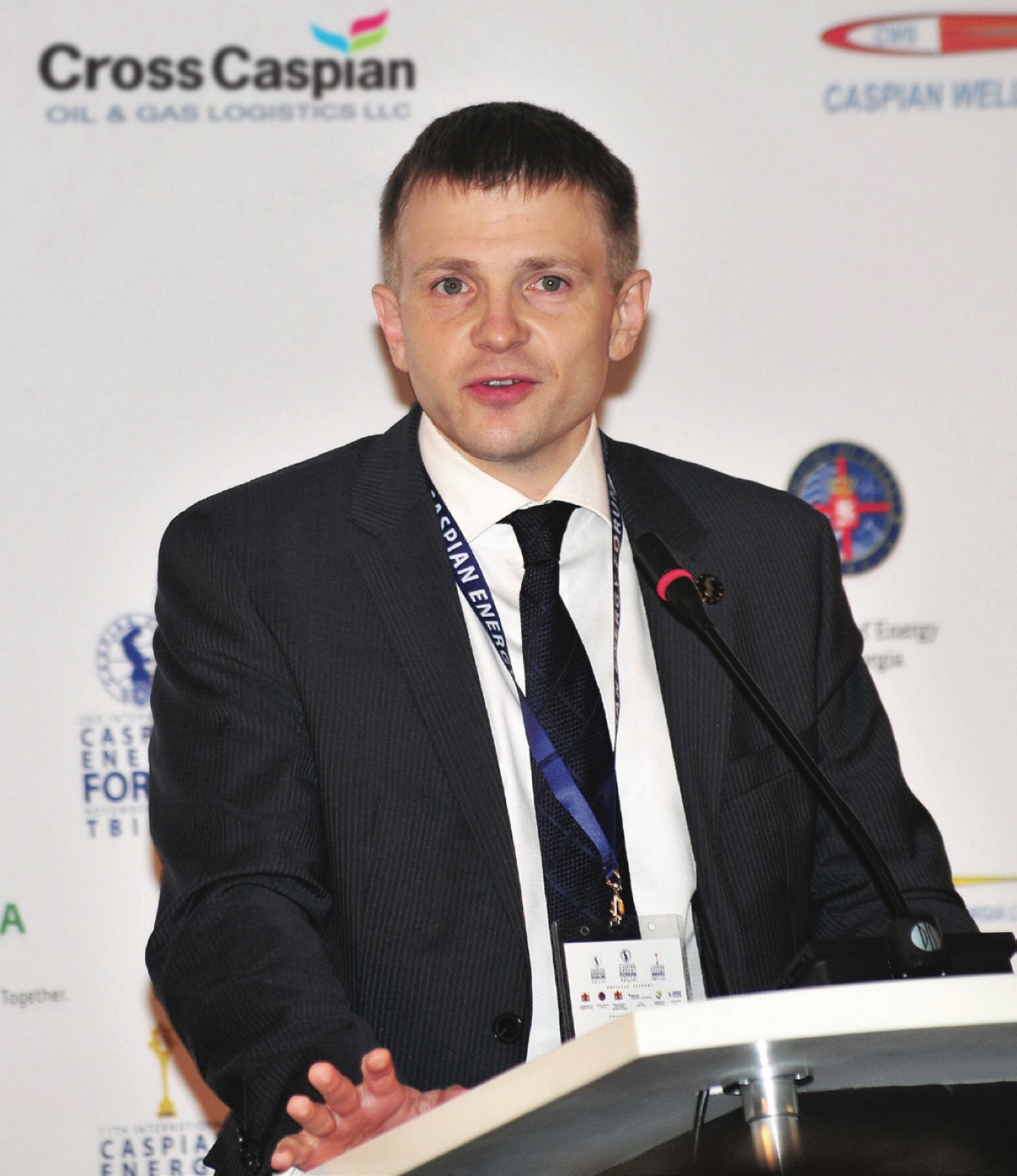
Caspian Energy (CE): Mr. Solovyov, what are the performance figures of the company over the year amid the unstable situation observed at world oil markets?
Dmitriy Solovyov, General Director of Cross Caspian Oil & Gas Logistics LLC: The situation remained stable during the year. A certain volume of oil products was transported to the Black Sea ports of Georgia via the Caspian marine terminals located in Azerbaijan. Oil produced at Turkmen fields was delivered to the Baku-Tbilisi-Ceyhan (BTC) pipeline. Part of this oil was shipped from the Dubendi and Sangachal terminals by railway to the Batumi terminal in Georgia.
Turkmen oil is currently shipped into BTC. Certain volumes of oil products of Turkmenistan and Kazakhstan are transported in the direction of the Black Sea terminals of Georgia. Vitol Company is transporting significant volumes of vacuum gasoil and fuel oil, produced in Kazakhstan, in the direction of Kulevi and Batumi terminals in Georgia. As far as global tendencies are concerned, it should be noted that crude oil prices firmed up in the range of $50-55 per barrel in 2017 which in its turn indirectly stabilized the market of crude oil and oil products transportation.
At the same time, the construction of the Garadagh terminal is ongoing and scheduled to be completed late in 2017. For several years the terminal has been operating condensate units designed for transportation of gas condensate, produced at Shah Deniz field, to the marine oil terminals in Georgia. Besides, this year we also plan to complete the construction of units designed for processing of transit volumes of crude oil and oil products.
CE: Was there an increase observed in the transit volumes last year?
Dmitriy Solovyov: It is hard to tell about significant increase of transit volumes as the balance of oil production and oil refining in the region is remaining stable now. Thus, substantial additional volumes of transit hydrocarbons can be sought only through the lens of crude oil production growth.
In this respect, Kazakhstan’s oil is considered as a major source for significant growth of transit in perspective.
At present Kazakhstan has most of crude oil, produced at such fields as Tengiz and Kashagan, being transported via CPC the carrying capacity of which was increased up to 67.5 mln tons per year. Thus, CPC has enough capacity now to transport this oil. But in general, the need to diversify risks of oil producing companies, the launch of the project on expansion of the Tengiz field and growth of production at Kashagan within the next few years can lead to appearance of additional transit volumes. So, considering our more than an 8-year fruitful cooperation with Tengizchevroil, we will compete for these volumes.
As far as transit of oil products is concerned, it mainly involves Turkmen oil products and certain volume of heavy distillates produced in Kazakhstan. However, the volumes of oil processing at Turkmen oil refineries are not increasing. So, it is quite difficult to seek new sources of growth of oil products transit in the short term. As to Kazakhstan’s oil products, it is mainly fuel oil and vacuum gasoil which were and are still being transported via the corridor in approximately the same volumes as before.
One should understand that there are certain directions which will attach top importance to the traditional structure of customers and geographic location of any given oil refineries. For instance, Seydin Oil Refinery in Turkmenistan, located close enough to such market as Afghanistan, is processing part of volumes. Apart from this, it is possible to supply such cargoes to Afghanistan by transit via the ports in the Caspian Sea. Considering high prices at the market of Afghanistan, as well as the absence of relatively tough requirements for quality, the economy of this market is of broader interest to products that Turkmenistan is producing. Namely, that would be diesel fuel and petrol 80/92. But in the meantime, transportation of a number of oil products such as fuel oil, vacuum gasoil, hydrotreated diesel, naphtha and TC-1 via our corridor is of importance both to the Georgian market and to the transit in the direction of the Black Sea terminals of Georgia ( Batumi, Kulevi and Poti) for further shipment to the world markets.
CE: Can the Baku-Tbilisi-Kars railway, which is under construction now, promote broader attraction of energy resources into the corridor via Azerbaijan?
Dmitriy Solovyov: This issue should be considered fully. As far as crude oil is concerned, it is difficult enough to compete with BTC because when it comes to crude oil, the economy and comparative easiness of cargo processing usually push cargo owners, who often have stakes in such systems (usually the case with state and international oil companies), make a choice in favor of pipeline systems. A pipeline is usually one of the most cost-effective solutions, it is simpler in terms of logistics, safety and environmental protection, as well as health safety in the course of its operation. As far as oil products are concerned, this matter has to be studied because the market of oil products means in general a spot market. There are many factors impacting the market shaping. In addition to the cost of logistics, there are issues concerning the aspects of volumes of consumption, alternative routes of delivery, alternative sources of oil products, a real experience of operating the route, including delivery time, difficulties with availability of capacities for offload of oil products upon their arrival at the point of destination and their further transit. Specifics of oil products markets can in some respects promote the possibility of railway transportation to longer distances. But the matter of transportation costs is important here because a railway transport traditionally costs higher compared to the maritime transport. For instance, oil products are shipped in relatively smaller consignments than those of crude oil. And in summer season it is possible to reach the Black Sea ports from the Caspian via the Volga-Don channel and sell this freight on a board of small and medium deadweight tankers in the Black and Mediterranean Seas.
Nowadays Caspian ports receive and transship freights by means of railway as well. They send the cargo to the Black Sea terminals in Georgia where it is possible to have oil products accumulated and loaded in large volumes on crude carriers 45 TT or on much bigger ones. Extension of the railway transportation is a quite complicated issue after the maritime transportation comes in because it is hard to compete with the water transport because of much lower cost of the latter.
The overland transport can have certain advantages only when no near ports exist at points of destination, when an overland route is shorter or navigation is complicated for certain reasons. Nevertheless any infrastructure always has a potential and its advantages have to be used.
A new route may be interesting for transportation of certain petroleum products and petrochemical products.
CE: What opportunities can Cross Caspian Oil & Gas Logistics LLC offer to cargo shippers?
Dmitriy Solovyov: Serious cargo owners first of all value professionalism and reliability. Flexibility in provision of complex services and gained experience are our trademarks. We have transshipped significant volumes of crude oil towards the entry point of BTC, as well as crude oil and oil products via Batumi, Kulevi and Poti terminals. It is tens of millions of hydrocarbons, experience, stability, safety of cargo, zero problems with maintenance of cargo quality and quantity, as well as segregation of different sorts of oil and types of oil products, it is accumulation and shipment in accordance with the time agreed with a consignor, it is an ability to offer a client flexible terms of cargo processing which means we can use several terminals, redistribute capacities in case of necessity. It is also a total fulfillment of all our contract obligations. We always analyze our work actively, seek ways to increase efficiency of services, optimize prime costs of services and always try to be competitive without undermining the quality and security of services we offer. Environmental and health safety are prioritized aspects in our activity. Technical aspects have been worked out in this regard, which cannot be compromised even if they serve as a potential source for reducing the cost of hydrocarbons transportation.
We find it one of the important factors which serve for serious clients as an indicator of stability and reliability of the route and transport services we offer. There is always a commercial and legal component in addition to the technical work because it involves big volumes of cargo, sufficiently high cost of cargo, and it is also natural that cargo shippers have high requirements in regard to the financial standing of transport companies. From the legal point of view the contractual scheme requires deep understanding of peculiarities of industrial standards, accuracy, knowledge of the international and local legislation of countries which the transportation goes through, as well as commercial flexibility and deep knowledge of technical features of applied transport assets.
In general, despite the instability of oil market prices, Azerbaijan has proved to be a reliable, stable logistics hub, and that regardless of the world economic situation the Caspian-Black Sea Corridor has been and will remain a stable solution for serious cargo shippers.
