


Caspian Energy (CE): Mr. Ismailov, could you please tell about the progress in reconstruction of the Heydar Aliyev Oil Refinery within a year?
Elman Ismailov, Director of SOCAR Heydar Aliyev Oil Refinery: The reconstruction and modernization works at the Heydar Aliyev Oil Refinery are currently underway under the instructions of President Ilham Aliyev to ensure compliance with the Euro-5 environmental standards, to manufacture petroleum products withstanding competition on the domestic and foreign markets and to meet the demand for petroleum products on the domestic market until 2030.
Over the year we almost completed the basic engineering (Pre-FEED) and front-end engineering design (FEED) of all units. SOCAR-Fugro already completed the survey work (analysis and assessment of soil) on the refinery’s site for all units and provided the report which was used to perform the front-end engineering design.
The FEED-design is being performed by the alliance of companies Amec Foster Wheeler (AFW) and SOCAR Foster Wheeler (SFW). At the next stage we should select an EPC contractor (Engineering, Procurement, Construction).
Currently, ITB documents have been prepared and sent to 7 companies. We expect companies to submit their bids by the mid of the 3rd quarter of this year. Then, within 2-3 months bids are to undergo the technical and commercial assessment in accordance with the requirements set out in the ITB documents.
Two tender packages are scheduled: the first one includes construction of new facilities, and the other one includes renovation of the existing units and offsites.
SOCAR Foster Wheeler Engineering LLC (established to support the development of local staff) was involved to perform the project works, and IPMT group (integrated project management team) was created to manage the project. The group involves the specialists from SOCAR, the Heydar Aliyev Oil Refinery and the KBR/SOCAR-KBR alliance of companies.
UOP is the licensor for the catalytic cracking unit, coke-naphtha-hydrotreatment unit, Merox unit and amine scrubber, Axens is the licensor for the diesel and petrol hydrotreatment units, Technimont is the licensor for the sulfur production unit, Poerner is the licensor for the bitumen unit, and Air Liquide (AL) is the licensor for the hydrogen production unit.
CE: Which units are to be built? What will be their technical specifications?
Elman Ismailov: First of all, as you know, after revamping the capacity of the ELOU-AVT-6 crude oil distillation unit will grow from current 6 to 7.5 million tonnes per year, the capacity of the catalytic cracking unit will increase from current 2 to 2.5 million tonnes per year. The remaining units are designed for capacity capable to receive those volumes.
The main objective of modernization and reconstruction is to obtain motor fuel (petrol and diesel) meeting the Euro-5 standard. Execution of these works consists of 3 phases.
A new bitumen unit shall be commissioned by July 2018 with the first phase.
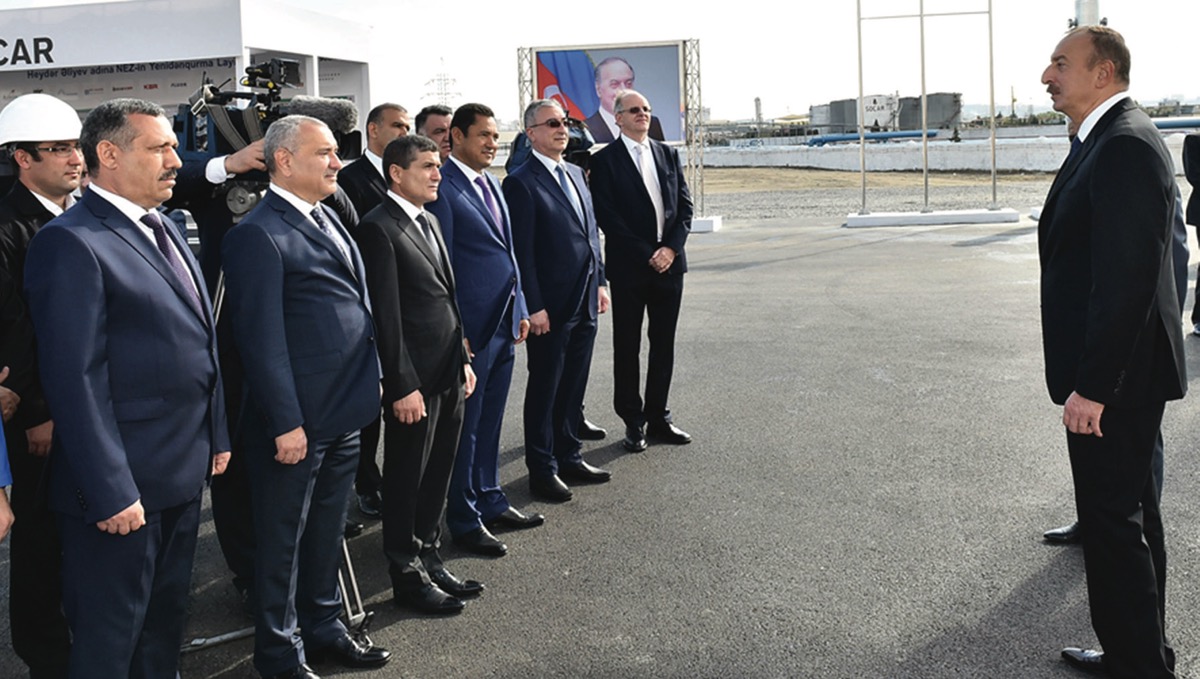
On September 19, 2016, President Ilham Aliyev attended the groundbreaking ceremony for the new bitumen unit within the framework of the Refinery Reconstruction Project.
The production capacity of the new unit will be higher than that of the existing one. The old unit is producing 250,000 tonnes per year, while the capacity of the new unit will be 400,000 tonnes of products per year. The unit will produce road bitumen EN 40/60.
The basic engineering and front-end engineering design of the bitumen unit are over. The detail engineering will be completed in July 2017. By means of the tender AZFEN has been selected to construct the bitumen unit. Currently the work is underway to conclude an appropriate contract. Construction of the unit will be commenced at the end of April.
With the construction of the new bitumen unit, the current infrastructure of the former Azerneftyag Oil Refinery will be completely decommissioned, and landfall sites will be released and handed over for implementation of the White City Project. In addition, operating costs of the Heydar Aliyev Oil Refinery will be optimized, and the country will be provided with high-quality oil bitumen.
The second phase is the diesel phase. A diesel hydrotreating unit with the capacity of 3 million tonnes per year will be built. A unit with the capacity of 45,000 cubic meters per hour will be built to provide the unit with hydrogen. At the same time a unit for sulfur removal from diesel fuel and sulfur processing with the capacity of 13,000 tonnes per year will be built.
The diesel phase also includes construction of the steam unit for acid waters, the Merox unit for LPG production and the amine scrubber. The works under the second phase will have been finalised by the mid of 2020.
At the same time works will be performed within the framework of the third phase, namely the gasoline phase. These works are scheduled to be completed by the end of 2020. A hydrotreating section of the catalytic cracking unit, the isomerization unit and the MTBE unit will be built to increase the octane number of gasolines.
At the same time works will be conducted at the utilities areas. Transfer lines and furnaces of the catalytic reformer will be replaced, and a hydrogen enrichment unit will be constructed. Additional facilities for wastewater treatment and bringing the content of oil products in sewage waters to 5 ppm will be built. A unit for purification of acid waters and condensate formed as a result of evaporation and a water demineralization unit will also be constructed. It is also planned to modernize the existing wastewater treatment unit, as well as to reconstruct the existing biological water treatment unit.
In addition, we have the commitments to SOCAR Polymer under which from October 2017 the Refinery will supply 150,000 tonnes of propylene and 120,000 tonnes of ethylene. In this regard, a propane-propylene pier is at the design stage.
Upon modernization the refinery’s capacity will be able to increase by 25%. The refinery will produce 1.9 million tonnes of gasoline per year instead of current 1.2 million tonnes (25% of total production of petroleum products at the Refinery), 3 million tonnes of diesel fuel per year instead of current 1.9 million tonnes (37%), 1 million tonnes of kerosene per year instead of current 700,000 tonnes (13%) and 25% of other types of petroleum products.
Therefore, the reconstruction of the Refinery will have been fully completed by the end of 2020. The project is financed by the government according to the instructions of President Ilham Aliyev.
CE: What are the main results of the economic activity of the Company?
Elman Ismailov: At the end of the year the Refinery’s management team and staff achieved good results in fulfilling the SOCAR’s production objectives and instructions. Thanks to the maximum use of the human and technical potential, we successfully implemented the production program.
Over the period under review the Refinery processed 6,094 thousand tonnes of feedstock, of which 6,070 thousand tonnes of oil and 24,000 tonnes of semi-finished products.
Despite the fact that according to the instructions of SOCAR the Refinery worked in the “mazut regime” in the winter months in order to provide Azenergji OJSC with fuel oil in the cold season, during this period works were carried out to optimize the Refinery’s core activities. The rational use of production capacities of all process units, especially the processes of processing the heavy and light feeds, was put in place at the Refinery thanks to the oil refiners, and the conditions were created for production of more expensive oil products from the existing resources of residual components of lower value produced after processing. For the “mazut regime” period under review we have brought the processing depth up to 90% which complies with the plan figures.
Last year the Refinery produced 1,139.6 thousand tonnes of motor gasoline, 2,509.2 thousand tonnes of jet and diesel fuel, 185.6 thousand tonnes of liquid gas, 206.6 thousand tonnes of petroleum coke, 179.1 thousand tonnes of oil bitumen, 68.4 thousand tonnes of DT and A motor fuels, 9.8 thousand tonnes of lubricating oils of different brands. For the chemical industry the Refinery produced 173.6 thousand tonnes of hydrotreated gasoline, 59.3 thousand tonnes of sweet dry gas. 398.6 thousand tonnes of fuel oil and other petroleum products were produced for Azerenerji and other organizations. In general, for the period under review the Refinery produced commodities worth 1,701.5 million AZN. 27.2% of the produced commodities went for export.
