


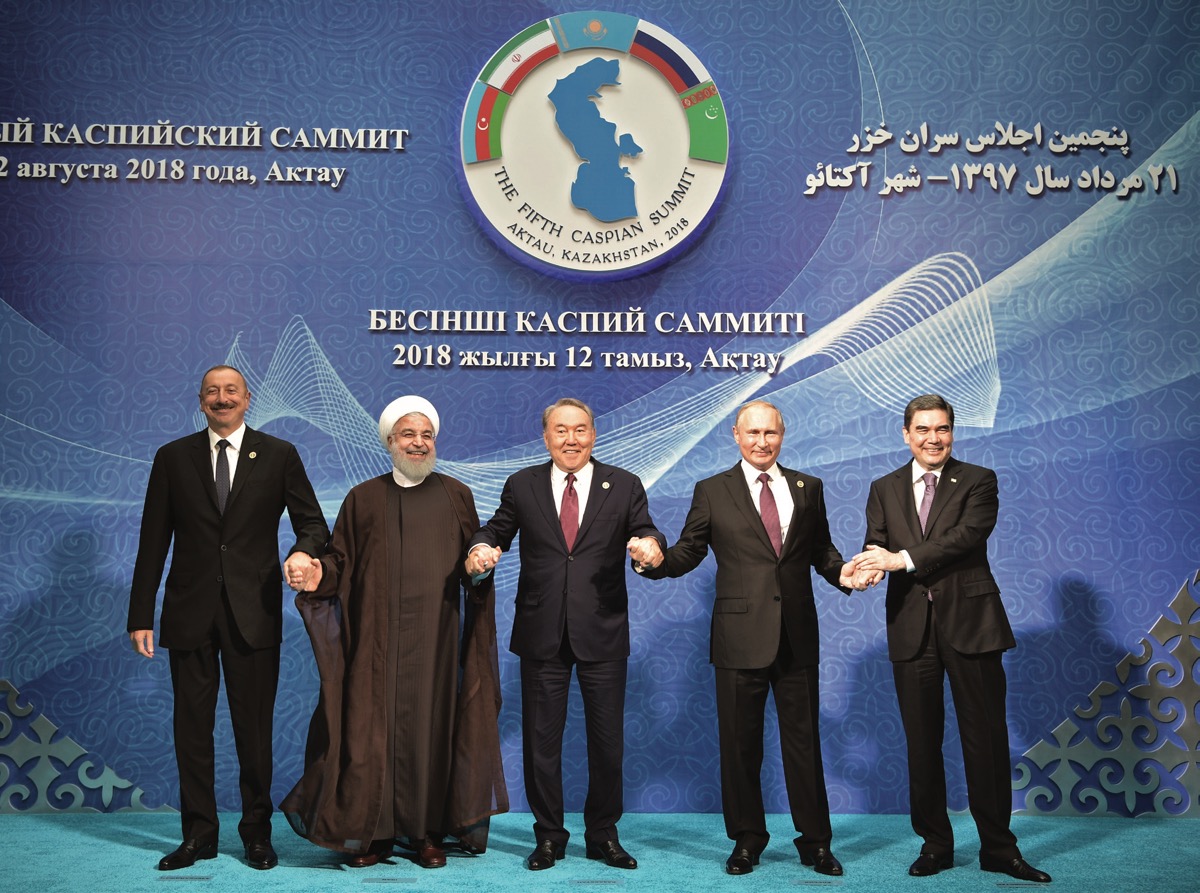
Economic aspect of settlement of the Caspian status (signing of the Convention on the legal status of the Caspian Sea by Presidents of 5 Caspian countries in Aktau on August 12) speaks for itself. The Caspian Sea comprises five countries with a total population of some 280 million. It is almost as many as in the MENA region (Middle East and North African states), about 300 million which is comparable with the market of the United States.
Geostrategic importance of the Caspian Sea lies in its being a central link between the rapidly growing economies of India and China, the region of MENA and the EU, the largest market in the world.
Today, when the WTO’s trade relations system, established after the Second World War, is being reviewed against the background of unstable oil market which has lost the trust of investors, the investment market is also “on the ropes” as the surplus of investments by the developed markets on the one hand and the lack of stability in the developing markets lead to a growing leverage of missed investment opportunities, right up to a new crisis of the world banking system. In addition, investment uncertainty of relations between Great Britain and EU after Brexit (March 29, 2019), as well as a shift to a “fair” bilateral trade system, collapse of trans-Atlantic and Pacific trade blocs (cessation of negotiations on TTIP –USA and EU and the collapse of TPP- 12 states), all this causes an investment uncertainty in the developed markets and provides new chances for business. Therefore, the Caspian together with its human capital, biological, energy, geo-economic and transport-tourism potential may in the very near future become one of the most liquid investment markets.
A long-awaited convention on the Caspian status signed on the 12th of August of this year in Kazakhstan will contribute to it. In spite of the fact that the convention does not fully settle issues of cross-border fields, Presidents of the five Caspian states positively assessed the signed document, noting that it would be a good base for further development of economic cooperation in the Caspian region. “Signing of the Convention of the Caspian status is a historical event. Azerbaijan worked in a constructive way and made its contribution. Caspian had been the Sea of stability and security even before the signing of the Convention. The Convention is determining the security of the Caspian Sea. Azerbaijan is contributing to the ecological issue, to the matter of environmental safety when performing oil-gas operations. This document will be important for the future of our countries”, President of Azerbaijan Ilham Aliyev said in his statement after the document had been signed in Aktau on August 12.
“The Convention is some kind of the constitution of the Caspian Sea. It is called upon to settle the full range of issues associated with the rights and obligations of coastal countries, and also become guarantor of safety, stability and prosperity of the region in general”, President of Kazakhstan Nursultan Nazarbayev said in his statement after the signing of the document in Aktau.
President of Turkmenistan Gurbanguly Berdimuhammedov offered to launch a mechanism of five-sided regular consultations under the aegis of the Foreign Ministers.
President of Iran Hassan Rouhani noted that the convention on the legal status of the Caspian Sea does not establish final dividing lines in the sea, which is why it is necessary to continue negotiations on this issue. “Negotiations, especially on division and determination of straight baselines, should be continued in order to reach agreements in respective areas in future by means of mutual understanding and constructive cooperation”, he said. According to H. Rouhani, “final adoption of the convention depends on legal procedures of ratification in the Caspian countries”.
“This event will certainly go down in history as the event which took place in Kazakhstan. It is a big event to which we headed for two decades: we were disputing a lot, searching solutions, and finally, we found it. It will certainly contribute to the development of our cooperation in the Caspian region”, President of Russia Vladimir Putin noted.
Thus, the settlement of the Caspian Status will likely stimulate creation of new mechanisms of establishment and development of economic relations, which depends on the level of development of the private sector in the Caspian countries, level of protection of economies from situations in the world markets, creation of the favorable investment background for attraction of new strategic investors and innovative technologies, favorable customs and tax procedures inside each state, and finally, the wish to follow the rules of free circulation of capitals and goods similar to the market of the EU. Conditions for creation and maintenance of new platforms for the business dialogue are also important. Implementation of new transport projects, infrastructure and the tariff policy reform shall contribute to the creation of competitive free local markets, free trade zones, international certification of products quality and mechanism of immunity of investments on the legislative level. In this case, the convention will certainly promote a more dynamic turnover of goods both between all 5 countries and the three global segments of the world market – EU, MENA, East and Central Asian markets.
History
The first international agreement which regulated the legal status of the Caspian Sea was concluded between the Russian empire and Persia as early as 1723 in Saint-Petersburg. According to the Saint-Petersburg agreement, Persia was deprived of the right for navigation in the Caspian Sea. Then the Treaty of Rasht was signed in 1732 which provided Persia the right for navigation, while Russia got a right for customs free trade in Persia.
The Soviet-Iranian treaties of 1921 and 1940 determined the status of the Caspian Sea in the 20th century. The agreement of 1921 removed the article of the Turkmenchay treaty, which prohibited Iran to have a military fleet in the Caspian Sea. Thus, the Caspian Sea was announced a Soviet-Iranian property. There were not borders set in the sea: the vessels of the USSR and Iran could move freely along the whole basin. The Soviet-Iranian convention on settlement, trade and navigation was signed in 1931, under which only the vessels of the coastal states can be in the Caspian. According to the internal directive, in 1935 the Soviet vessels were prohibited to sail south of the line between the mouth of the Astara and Atrek rivers.
Article 8, Convention on the legal status of the Caspian Sea
1. Delimitation of the Caspian Sea seabed and subsoil into sectors shall be effected by agreement between States with adjacent and opposite coasts, with due regard to the generally recognized principles and norms of international law, to enable those States to exercise their sovereign rights to the subsoil exploitation and other legitimate economic activities related to the development of resources of the seabed and subsoil.
2. Within its sector, a coastal State shall have the exclusive right to construct, as well as to authorize and regulate the construction, operation and use of artificial islands, installations and structures. A coastal State may, where deemed necessary, establish safety zones around artificial islands, installations and structures to ensure the safety of navigation and of the artificial islands, installations and structures. The breadth of the safety zones shall not exceed a distance of 500 meters around them, measured from each point of the outer edge of such artificial islands, installations and structures.
The geographical coordinates of such structures and contours of the safety zones should be communicated to all the Parties.
History
The first summit of the Caspian states was hosted in Ashgabat on April 23-24, 2002, but no serious success was achieved in determination of the status of the Caspian Sea. Then, the four countries offered to delimit the sea along the median line. Iran insisted on division of the basin into equal sectors. In addition, Turkmenistan offered to establish a 20-mile zone for free navigation in the middle of the Caspian Sea.
The Framework Convention for the Protection of the Marine Environment of the Caspian Sea came into force in August 2007. Protocols, to the framework convention, concerning regional preparedness, response and cooperation in combating oil pollution incidents, protection of the Caspian Sea against pollution from land-based sources and activities, and preservation of biological diversity were signed later. Summit in Tehran took place in October 2007.
The agreement announced here stated that only the vessels sailing under the flags of the Caspian states have the right for navigation in the Caspian Sea; that only 5 countries having an access to the Caspian Sea can participate in the negotiations. In addition, the summit decided to hold meetings of the heads of the Caspian states on an annual basis.
The third summit held in Baku in 2010 managed to solve one of the key issues of settlement of the legal status of the Caspian Sea: the breadth of the 24 mile long “national belt” was established. Besides, the parties agreed to work out final principles of delimitation of the Caspian Sea by the following year (2011).
The fourth summit which was held in Astrakhan in September 2015 turned out breakthrough, at least, that is the way the leaders of Kazakhstan and Russia marked the results of the summit. Leaders of the 5 Caspian states agreed about principles of the national sovereignty of each country over the coastal maritime space in the range of 15 miles and 10 “fishing” miles.
