



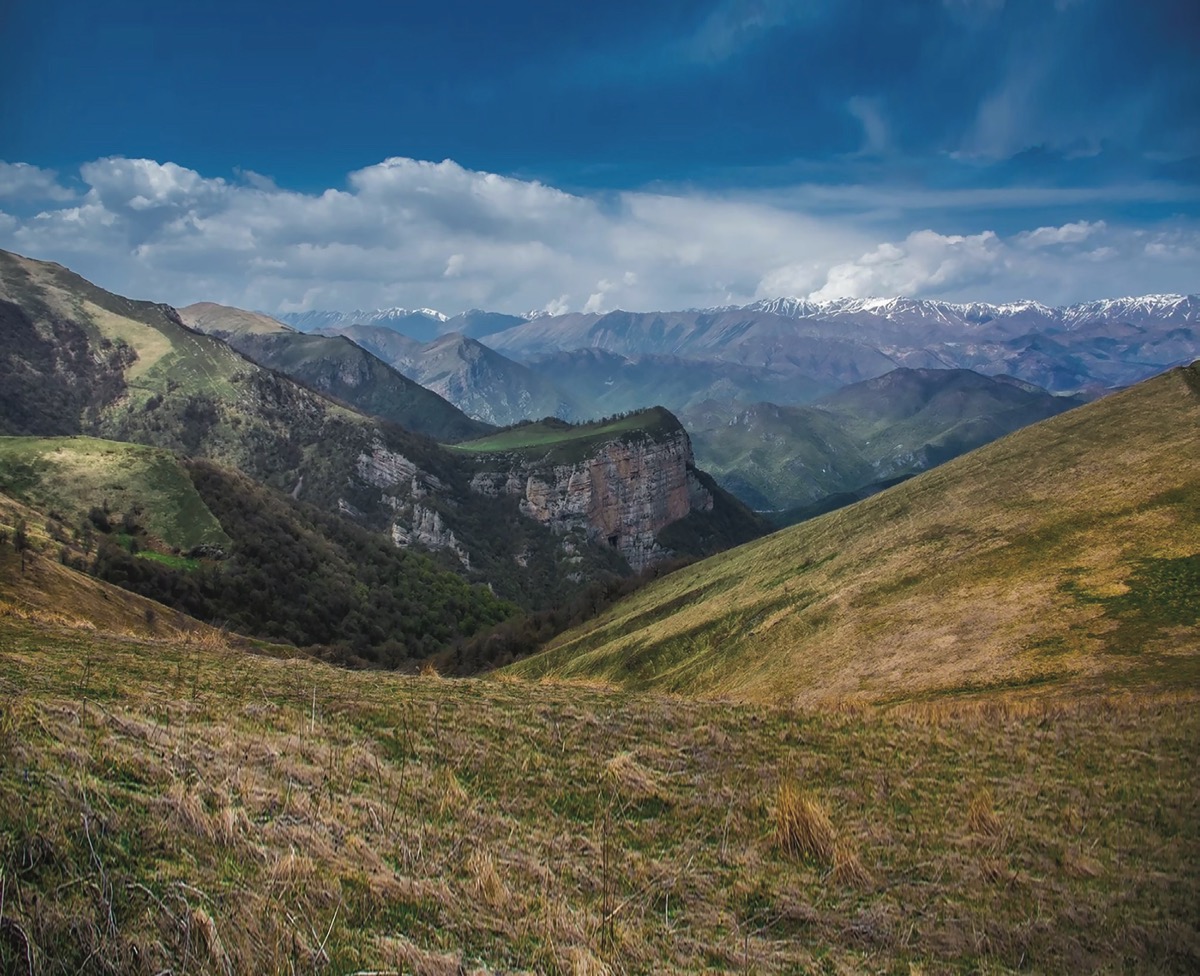
As is known, in 1989-1993 Armenia occupied Nagorno-Karabakh and the surrounding territories of Lachin, Kalbajar, Gubadli, Zangilan, Jabrayil, Fizuli-Agdam (the district center and much of the territory) and Fizuli (the district center and much of the territory) administrative districts of the Republic of Azerbaijan.
Nowadays, issues concerning the restoration of economic activities, economy, water balance, agriculture, industry and tourism are at the forefront of the agenda. President Ilham Aliyev ordered to create a temporary special administration in Karabakh, as well as work out a general plan to rebuild the infrastructure of the cities and villages razed to the ground over the 30-year occupation.
Special temporary administrations assigned to the territories freed from occupation will be engaged in protecting significant facilities of transport and telecommunication infrastructure, energy and water supply systems, reservoirs, sources of increased danger to people and the environment. They will also organize protection of public order and security, carry out search, collection and inventory of weapons, ammunition and military equipment. In cooperation with the government agencies, special commandant’s offices shall arrange mine-clearing and prevent diversion and terrorism attempts. The ministries of emergency situations, energy, agriculture, transport and others were ordered to assess the status of sectors they are in charge of and prepare plans for their development in the retaken districts.
Natural resources potential
Azerbaijan regained control over a 198km long section of the state border with Iran, stretching from Horadiz settlement to the border of Zangilan district, and over a 360km long section of Azerbaijan-Armenia state border (558km in total). There had been natural monuments, rare plants and animal species widespread in the occupied region before the occupation. The occupied mountainous zone of the Lesser Caucasus is a large forest area of Azerbaijan. The total forest area of the region was 246.7 thousand hectares, it became extinct as well.
A number of nature reserves were created in order to protect the natural landscape, the world of rare plants and animals on the territories of the Minor Caucasus. Noteworthy here are the Besitchay reserve, Lachin reserve and others. Besitchay reserve was created in 1974 in the south-west of Azerbaijan, on the now-liberated territory of Zangilan, in the valley of the Besitchay River. The area of the reserve is 107 hectares. The protected object here is the eastern plane tree. The plane-tree grove stretches along the river for a distance of 12 km. The existing trees are up to 500 years old. The territories are rich in subsoil and surface natural resources. The most widespread minerals are non–ferrous metal ores, gold, mercury, chromite, perlite, lime, marble, agate, mineral waters, and others. The territory also has a wide resort and recreational potential.
The below given table provides a list of mineral deposits located in the territories of the Azerbaijan Republic districts, plundered by Armenians.
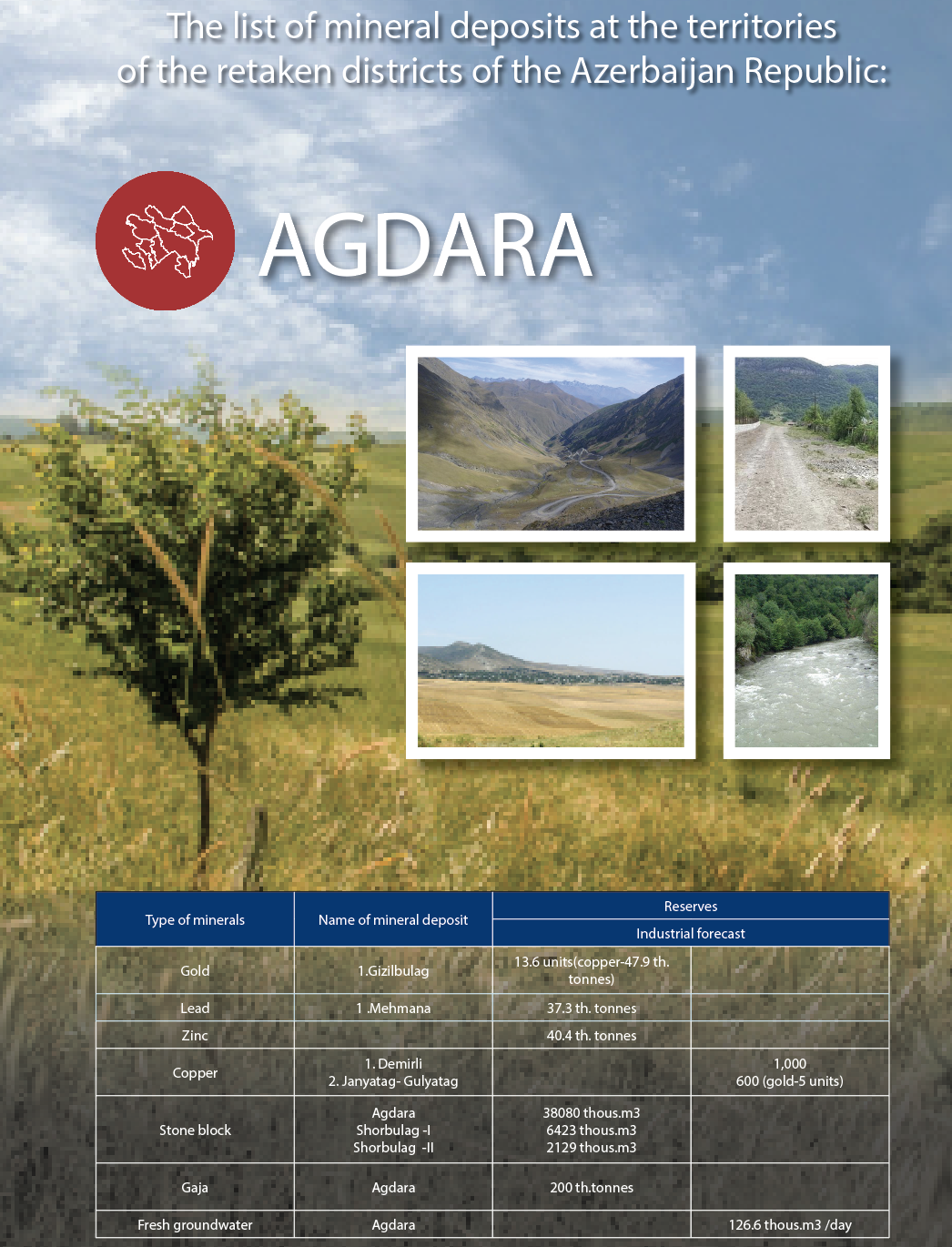
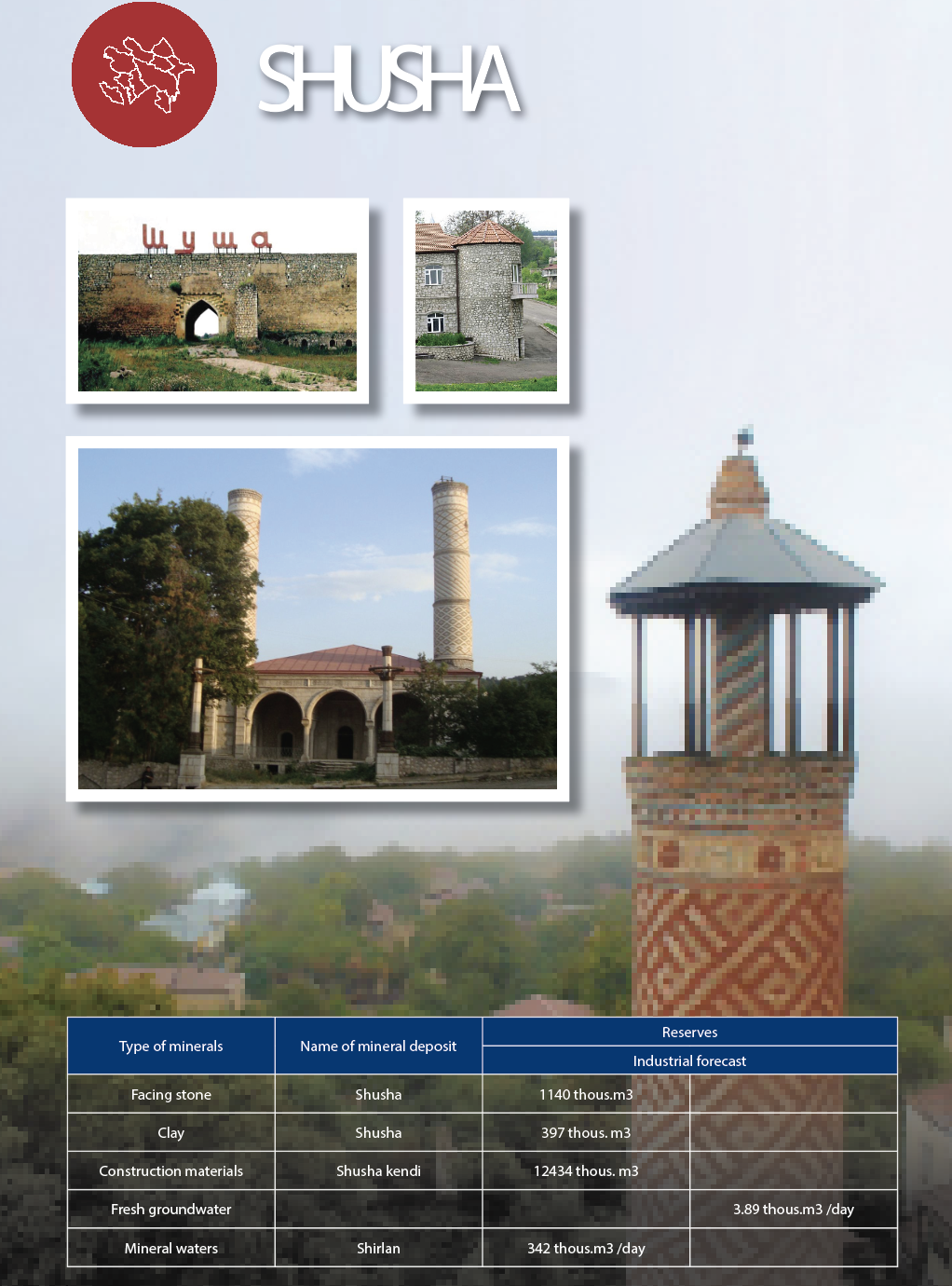
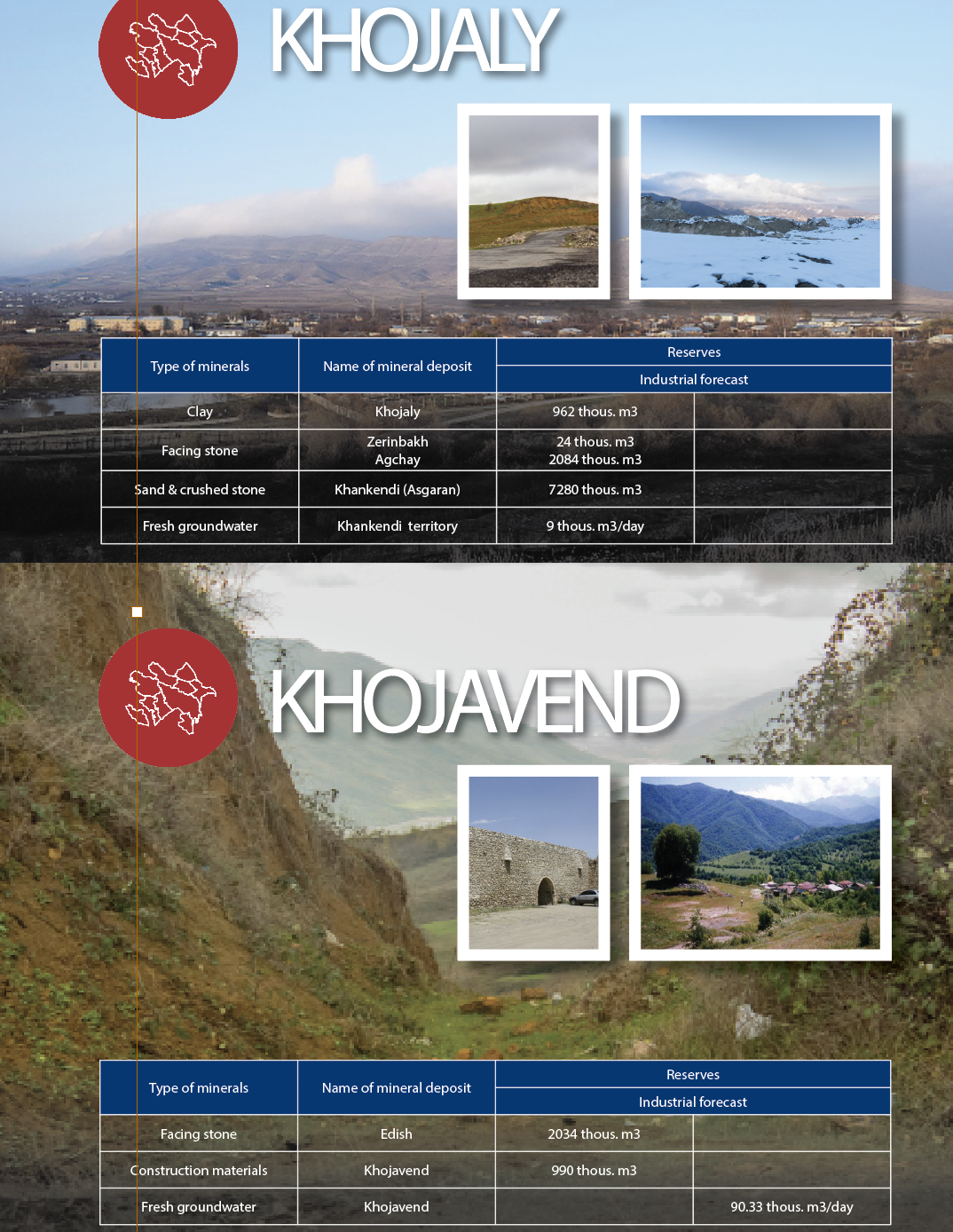
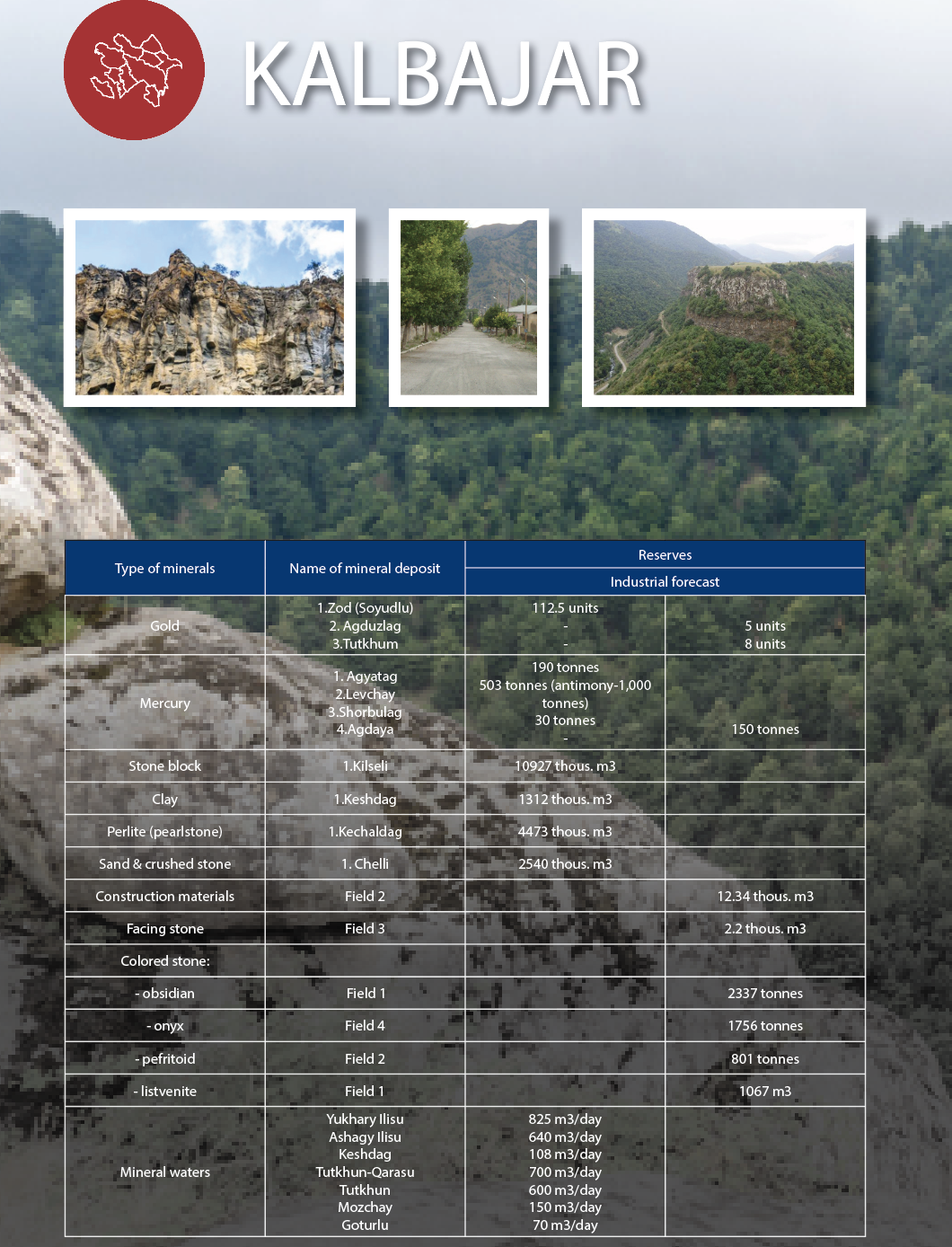
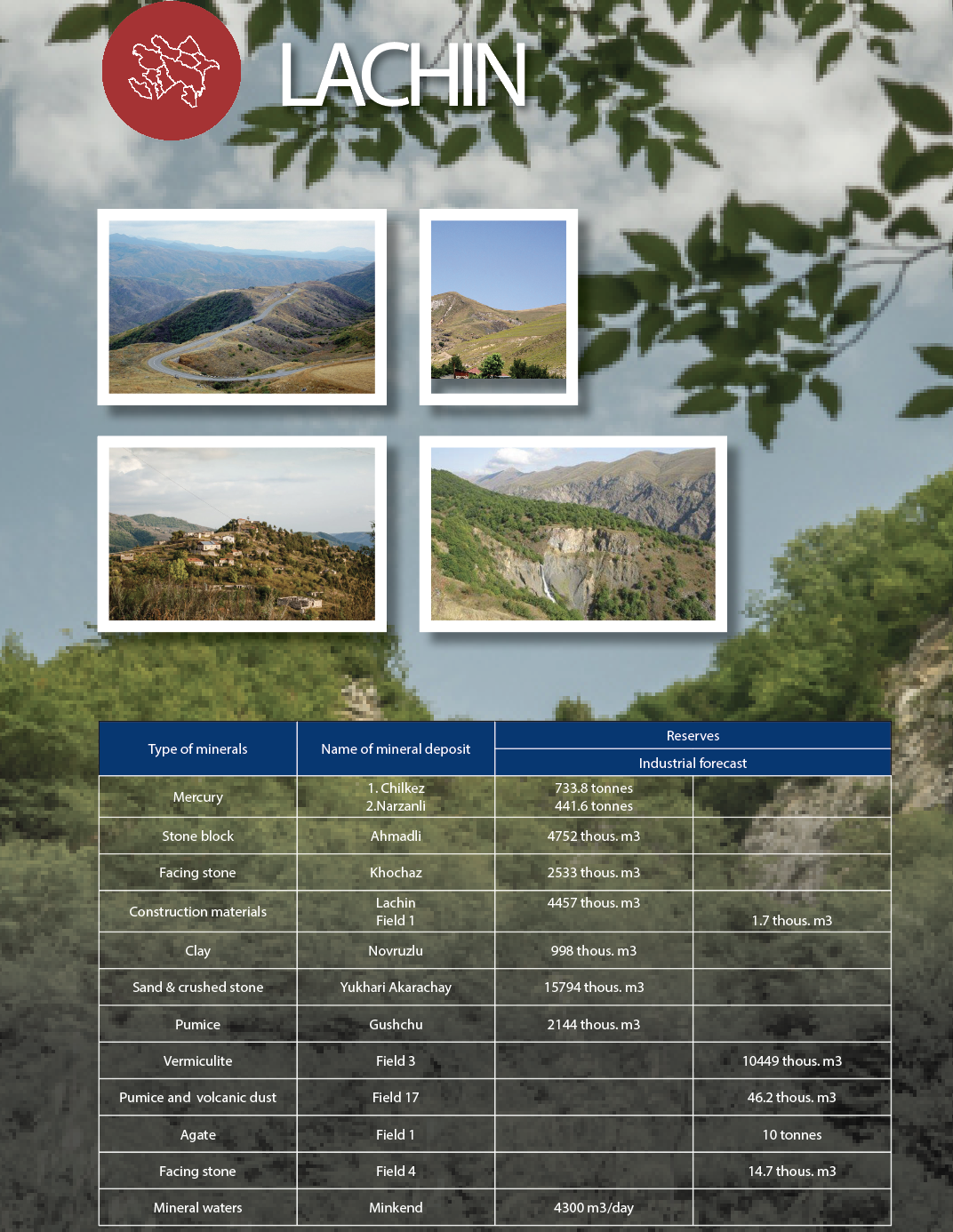
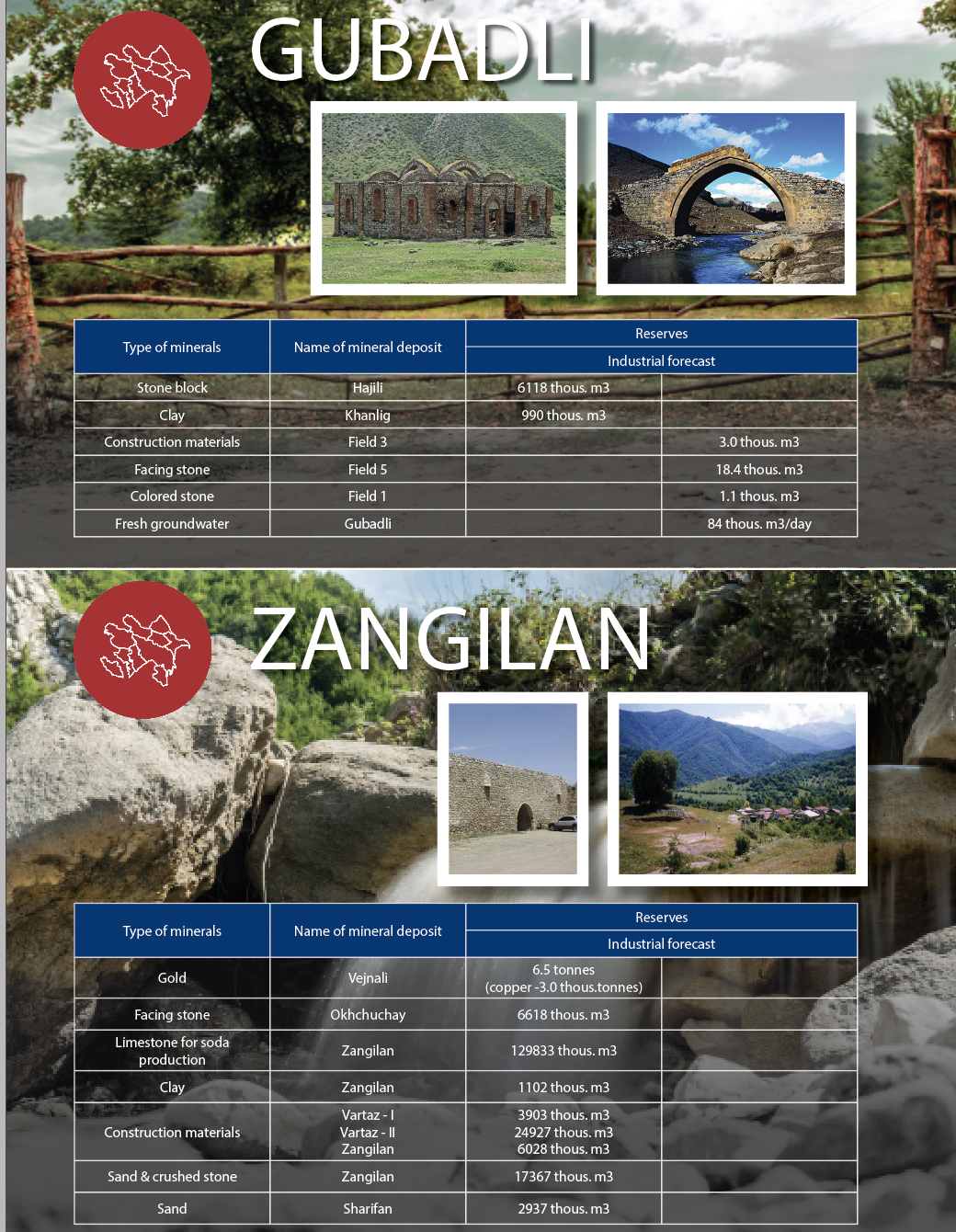
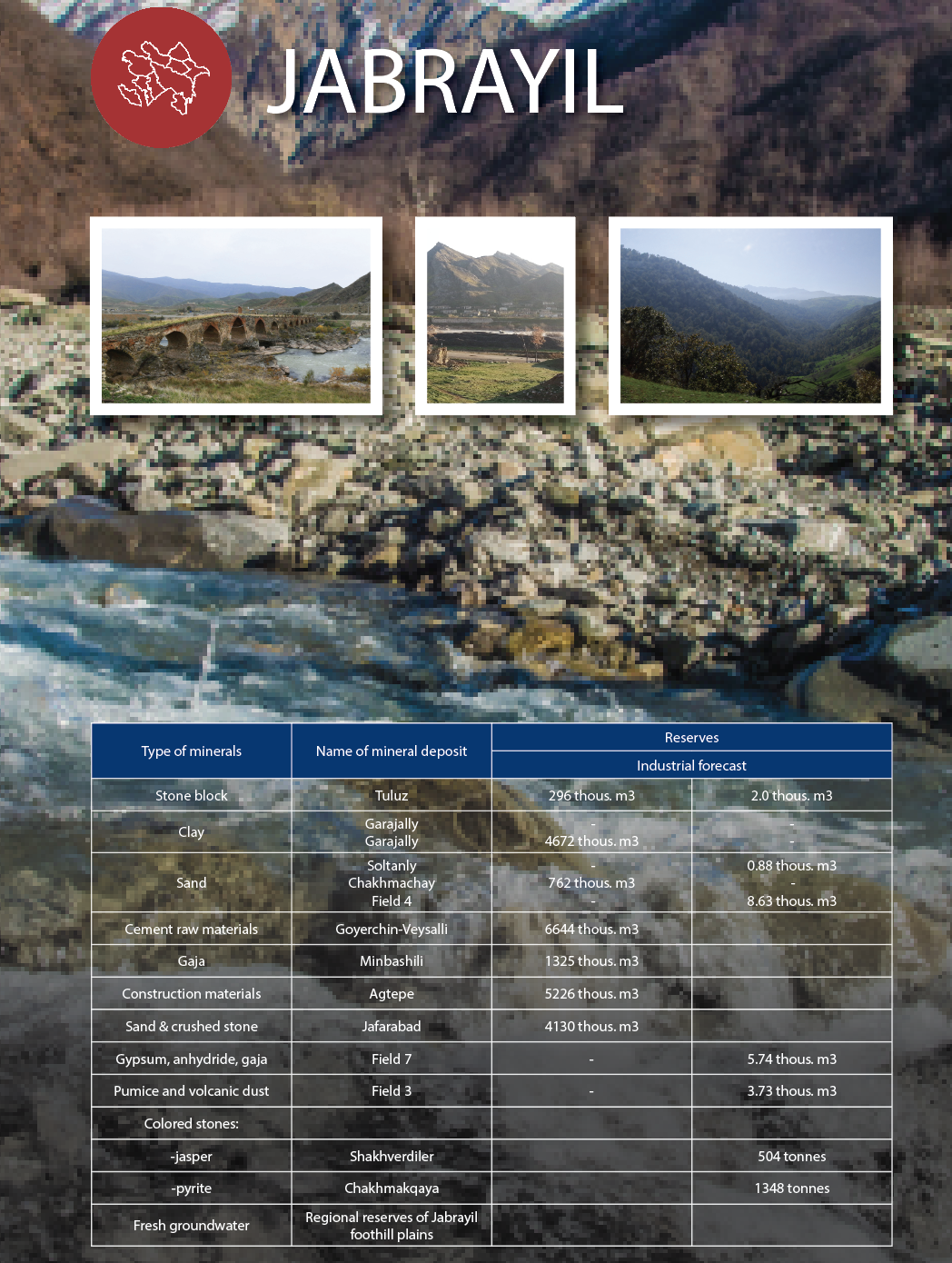
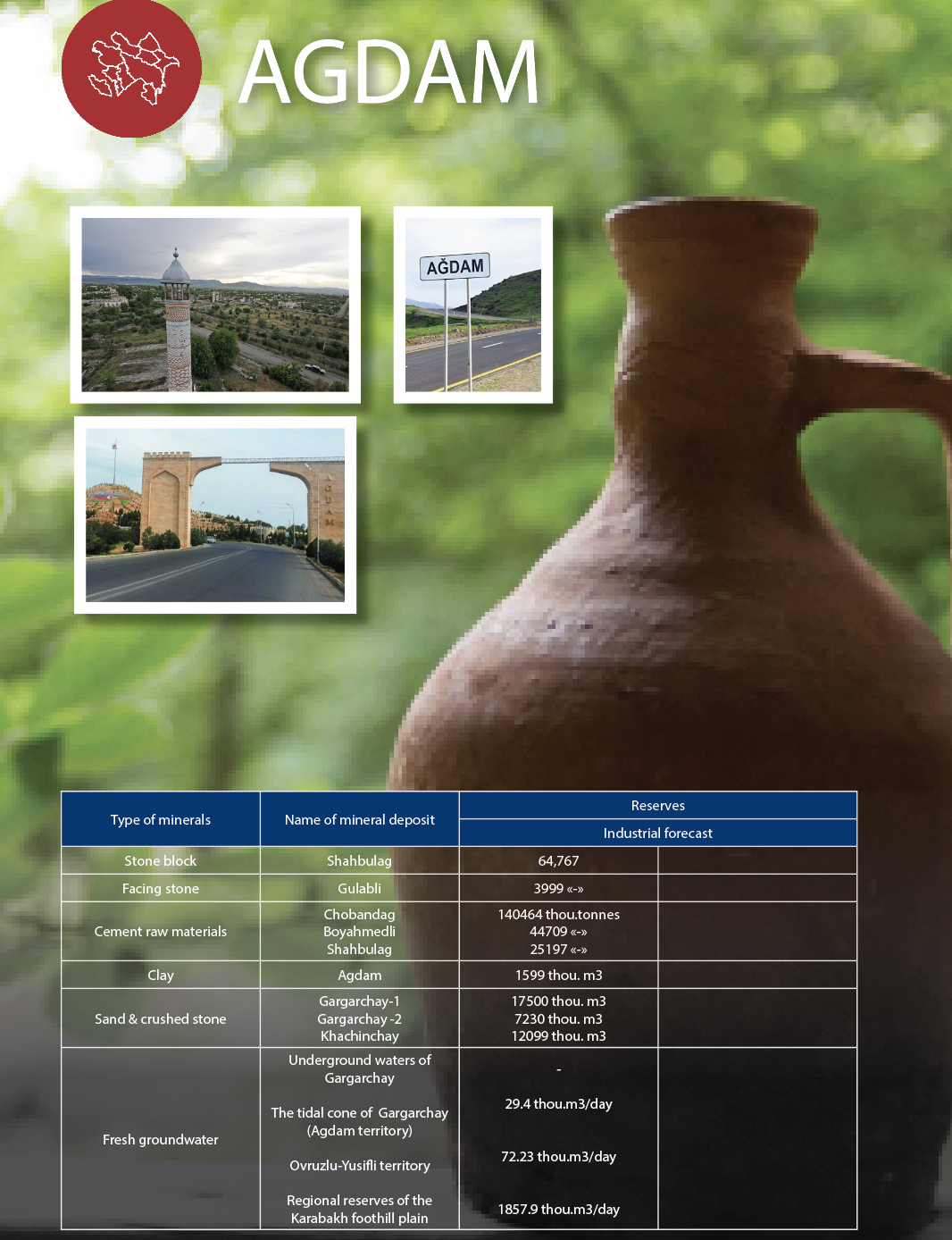
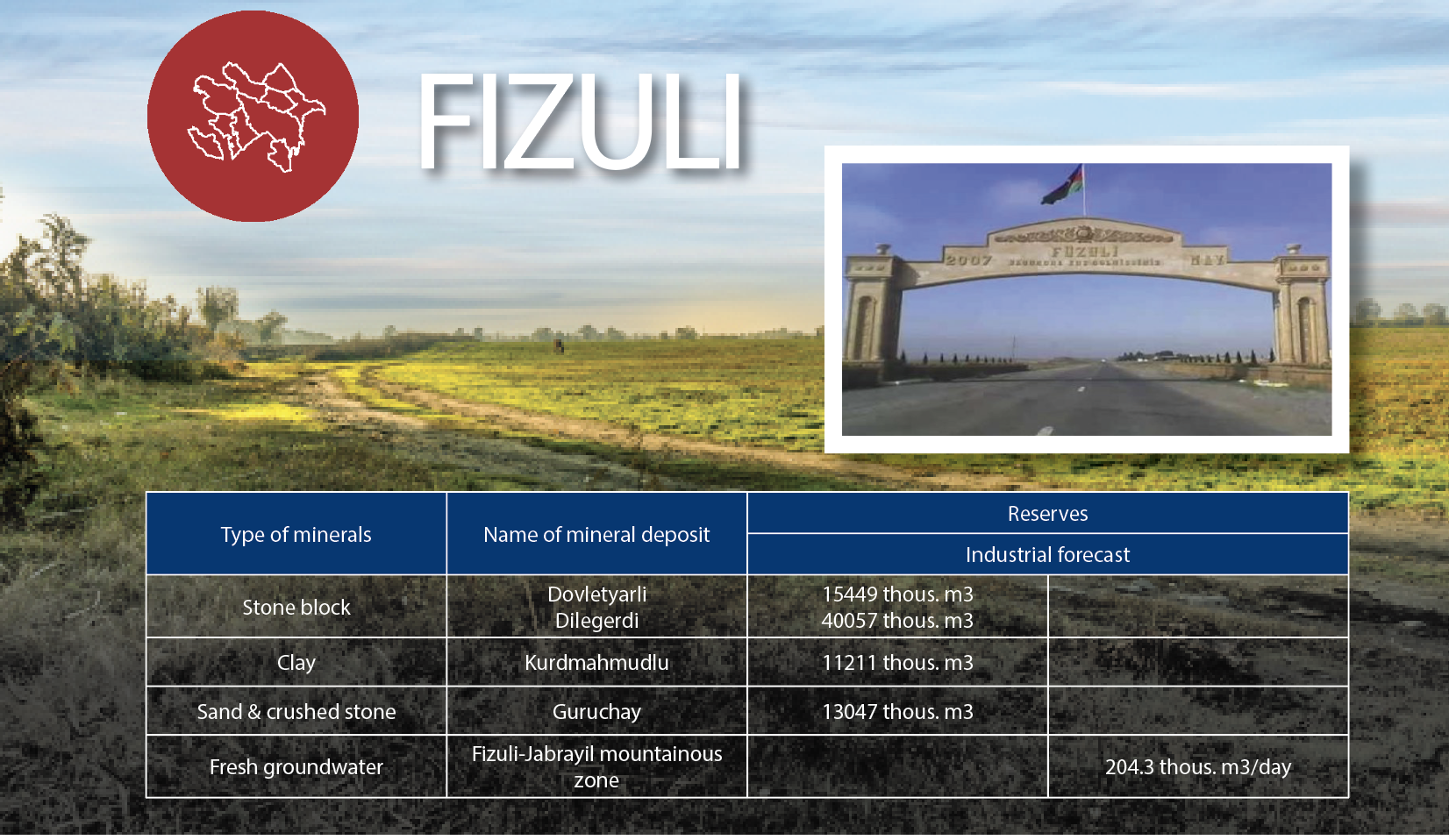
The tables are based on the data from the Ministry of Ecology and Natural Resources of the Republic of Azerbaijan
As seen, rare and valuable minerals are widespread in the region. Significant reserves of copper-zinc ores are concentrated in Mehman deposit, located in the east of the Minor Caucasus. Ready-for-use ore deposits have been explored here. Mercury reserves of industrial significance lie in Shorbulag and Agyatag fields of Kalbajar district.
These territories abound in various types of building materials that are important for the construction sector and industry of Azerbaijan. Large reserves of such materials lie in the fields located on the territory of Agdam district: Chobandag (lime reserves make 140 million tons and clay reserves are 20 million tons), Shahbulag (25 million tones of clay), Boyahmadli (45 million tonnes of clay) and others. There are big reserves of building stone in Khankendi, and marble in Kharov.
In the retaken territories there are up to 120 mineral water deposits of various compositions that are of great medicinal value. Noteworthy among them are Yukhary and Ashagy Istisu, Bagirsag and Keshdag fields in Kalbajar district; Iliqsu and Minkend in Lachin district; Turshsu, Sirlan in Shusha district and other mineral waters.
The mineral waters of Istisu, lying in the territory of Kalbajar district, outstand with a particularly favorable gas and chemical composition, high temperature and large natural reserves. These waters can be used to treat both internal and external human diseases.
In the 80s, a resort and a factory for the production of tarred mineral water were built at Istisu spring. This plant produced 800 thousand liters of water per day.
Turshsu mineral spring is located at a distance of 17 km from the city of Shusha in Azerbaijan. From time immemorial, Turshsu and Isa bulagi springs have been a place for musical and poetic meetings.
It should be noted that 39.6% of the total geological reserves of mineral waters in Azerbaijan used to lie in the occupied districts.
Economic relations that arise within national territories are defined by their historicity, stability and constancy. The Nagorno-Karabakh Autonomous region has always been part of Azerbaijan and was governed by its statehood. Khankendi is directly and closely connected with the Azerbaijan railways and highways, with the entire transport and communication system of the Republic. The distance from this center by rail to Baku is 392 km.
Thus, over the centuries, the mountainous part of Karabakh has developed in close economic links with lowland Karabakh. The roads that run along the river valleys strongly tied these two territories to each other economically. Untill recently, the occupation of Nagorno-Karabakh by the Armenians and its forcible separation from lowland Karabakh, despite all these historical and geographical realities, had been causing serious problems for the population and economy of the region.
But Azerbaijan will fix it all. Karabakh will be closely integrated into the region’s economy and Azerbaijan’s international projects. New transport routes will be built. The living standards of the population will improve, including its social protection. President of Azerbaijan Ilham Aliyev declares this in every speech. In particular, the construction of the first Fizuli-Shusha multiple lane road has already started.
