



With all the popularity of the renewable energy resources - solar, wind, hydropower, geothermal energy, wave energy and tidal energy which are increasingly coming “on the heels” of traditional hydrocarbons - all these sources have a seasonal nature of use, are extremely vulnerable and unstable (as observed in the recent cold weather of USA and Europe), and require improvement of storage, transmission and distribution technologies, as well as high costs for stimulating demand and subsidizing - over two trillion dollars, according to the Paris Summit.
In one word, a revolutionary technological breakthrough did not happen, which does not call off the gradual evolutionary breakthrough that should result in the abandonment of harmful internal combustion engines in most EU countries from 2030 and dial back the degree of heat within the planet’s atmosphere in accordance with the climate goals of the Paris summit. Also, the new US administration has already joined the Paris Climate Agreement. It probably will accelerate the development of renewable energy sources in 2021. The goal is to fully decarbonize the electricity sector by 2035. But much has already been accomplished in the past year.
So in 2020, the number of clean energy production facilities doubled in China. In the near future, the country expects record growth in this industry. In September, the President of the People’s Republic of China, Xi Jinping announced that China would completely stop carbon emissions by 2060.
In 2020, the volume of electricity generated by solar farms in Spain was 60% more than in 2019. The southern country has the largest solar potential in all of Europe. For now, Spain is noticeably yielding to Germany, the European Union leader in the use of solar capacities.
According to the environmental group Ember, about 40% of electricity in the European Union was produced from renewable sources in the first half of 2020. Power plants burning fossil fuels accounted for just 34%.
Last year was the most “eco-friendly” for the power system of Great Britain since the industrial revolution. The country went along without coal for 67 days. By 2025, Britain plans to completely abandon polluting fuels, as the share of energy coming from wind farms becomes larger.
However, if we take the indicators of consumption of fossil energy resources and gas for 10 years, we can see that without the 2020 covid crisis year they increased by 13% and 25% respectively.
In Europe, 75% of total industrial consumption falls to the share of oil, gas and coal. At the same time, almost a billion people in the world do not have access to electricity at all, and 2.5 billion out of 7.8 billion inhabitants of the blue planet cook food on an open fire, it is these groups of the population that are meant to be the main driver of the growth in demand for environmentally friendly resources and, first of all, for natural gas as the world economy grows.
That is why it is so important to maintain stable economic growth on the planet and prevent the reoccurrence of 2020 when the imposed force majeure dramatically plunged everyone into a future without hydrocarbons. No planes were flying, and many cars were parked. The unprecedented winter cold with rolling power cuts, freezing regions and cities in the United States, Europe and the Middle East, when people were forced to warm up in cars with the engines running, showed that it is a little early to live without oil and especially gas. Natural gas, especially its liquefied fraction, continues to prove its economic viability in relation to oil, and despite a 4% reduction in consumption through 2020 due to the coronavirus pandemic, gas has proved to be more stress-resistant to external shocks compared to the oil market. Yet the year of 2020 has brought a record decline in natural gas demand throughout the whole history.
Experts expect the demand to recover pretty soon. Early in 2021 global gas consumption will return to pre-crisis levels, and the growth of demand for natural gas in 2021 will make 2.8 percent. In this respect, the demand for ecological types of fuel will be driven by the increasing need for LNG. With increasing sources of supply, gas hubs of regional and international importance, it will lead to the untying from oil prices followed by the natural replacement of oil with liquid fractions of natural gas and alternative energy.
Despite the forecasts, the uncertainty amid the pandemic still makes this market vulnerable and suffering for new stable sources of supply, renewed demand stimulation and the formation of flexible LNG spot hubs.
Major event of 2021
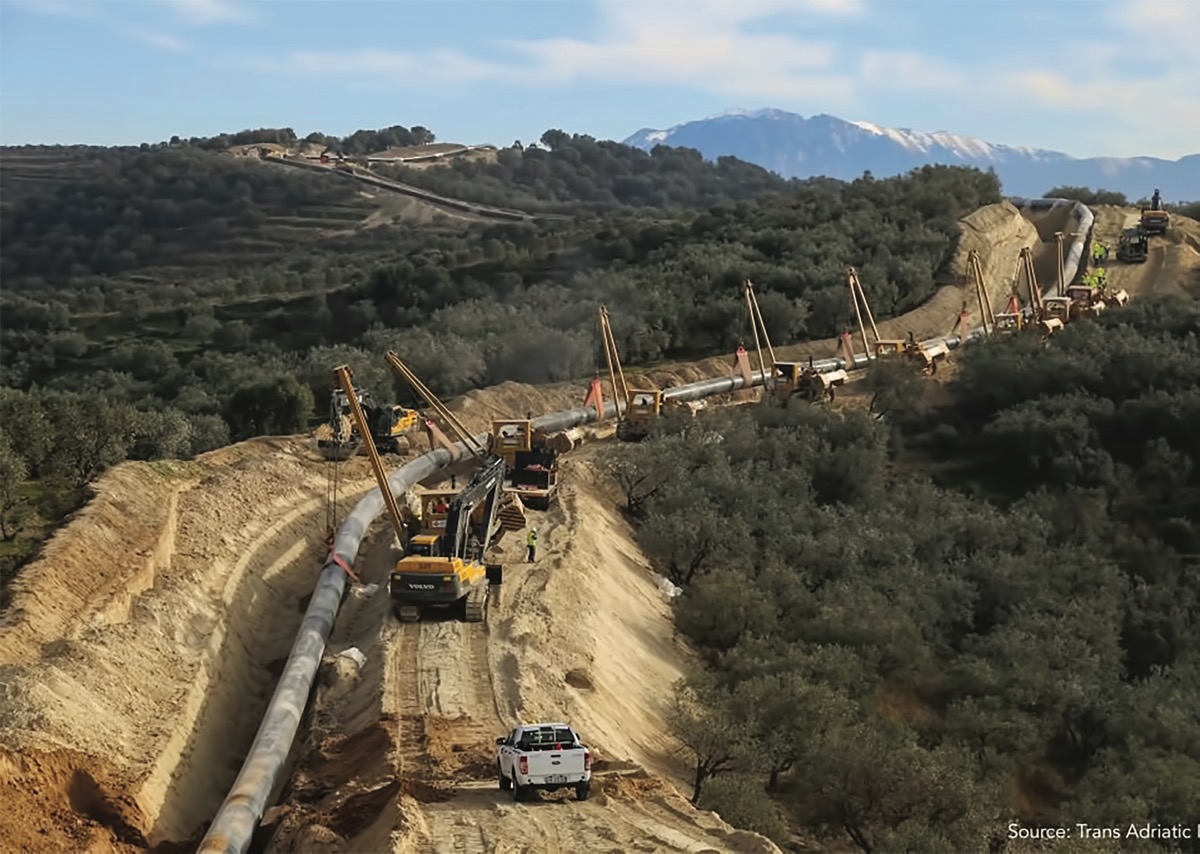
Perhaps, the main event of this year happened right at the beginning of it. The glass of champagne with natural and the most famous, to this date, environmentally friendly fossil fuel (found in three types – gaseous, liquid and solid) was officially raised on December 31 when the Southern Gas Corridor was put into operation - the result of long negotiations for 15 years. This is a new, unique, and most importantly, additional source of clean energy for the European and Asian markets. The gas through the TANAP pipeline was delivered via an interconnector to Greece and Bulgaria, and after passing through these two countries, it reached Italy at the interconnector point. For the first time in history, the five Caspian littoral countries were able to access the new export system, and for the first time, Caspian natural gas was transported to the European market via pipelines. Following the successful TAP connection to the Italian gas distribution network, commercial natural gas was delivered from Melendugno in Italy and from Nea Mesimvria to Greece and Bulgaria on 15 November.
The Southern Gas Corridor for the first time connected the old continent to the Caspian Sea via Turkey and the Balkans, it is a historic day for the gas sector, said Gilberto Dialluce, Director General of the Italian Ministry of Economic Development for Infrastructure and Energy Systems. The flow volume is about 11 million cubic meters per day. In January, 340 million cubic meters of gas were imported to Italy through TAP, of which about 70 million cubic meters were exported in the form of reverse flow at the interconnector point.
As President of Azerbaijan Ilham Aliyev noted at the VII meeting of the Southern Gas Corridor Advisory Council, “Looking at the Southern Gas Corridor project, one can see that it is really unique by many parameters. Its length makes 3,500 kilometers, the project unites 7 countries. Without close cooperation between these countries, this project wouldn’t have been possible to implement. It crosses very difficult terrain like 2,500 m high mountains, and more than 100 km of the pipeline goes under the Adriatic Sea. The Southern Gas Corridor is complying with the highest ecological norms. And that was one of the major pre-conditions while we were planning and implementing this project”, Ilham Aliyev said. The project will be fully commissioned in 2026.
Notwithstanding the statistics of spending increase in all projects of this scale as they develop, the cost of this project was originally estimated at $44.6 billion. However, effective management and proper planning made it possible to lower the project cost to 33 billion dollars. Azerbaijan has made a significant financial contribution to the project in the amount of $10 billion. The
