



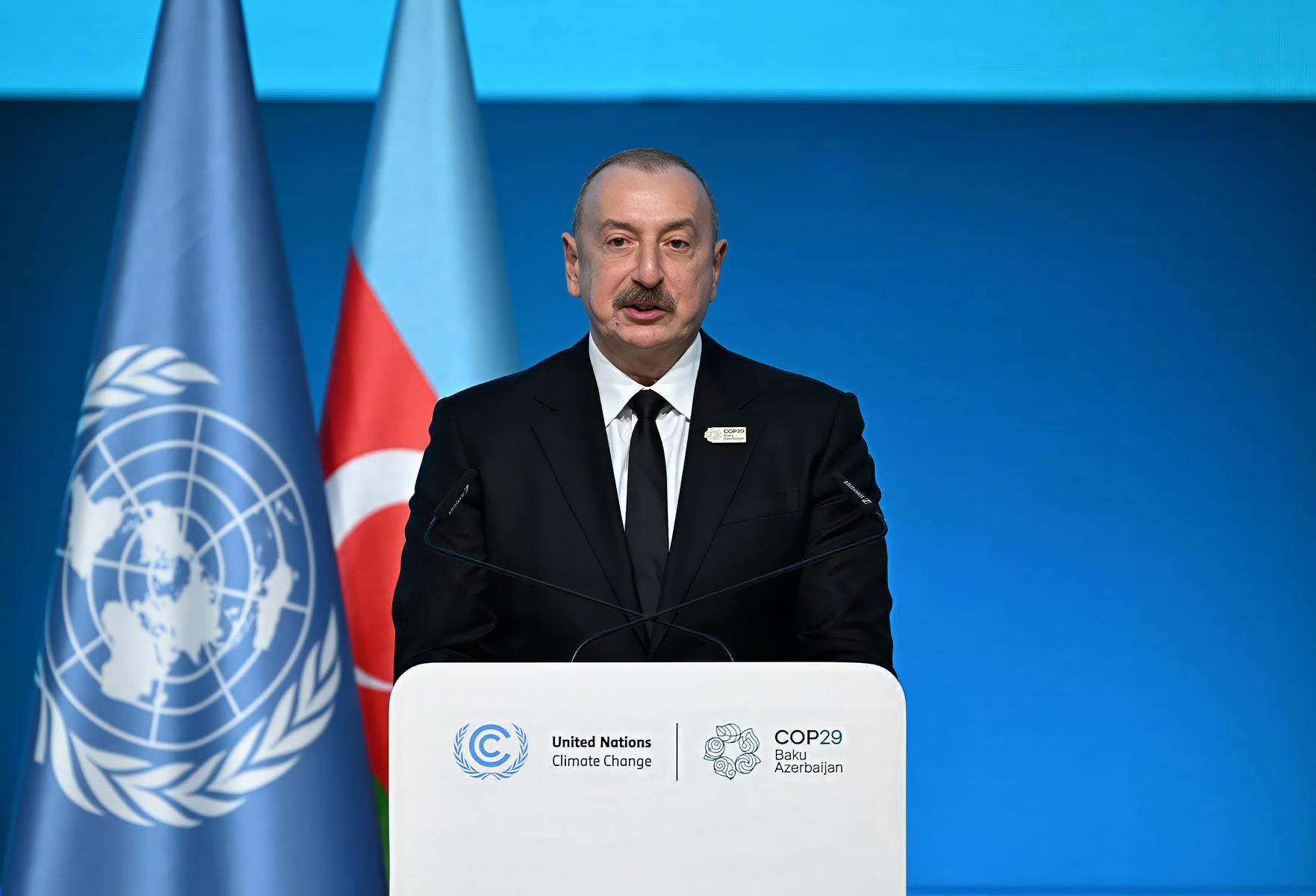
As if racing against time, the COP Presidencies Troika established under the UAE consensus during COP28, brings together former, current, and future COP Presidencies - UAE (COP28), Azerbaijan (COP29), and Brazil (COP30) - to undertake ambitious, collective actions in the fight against climate change.
This collaboration aims to maintain momentum in achieving key climate goals, with a special focus on the Roadmap to the Mission of limiting global warming to 1.5°C compared to pre-1990 levels.
COP29, held in Baku in November 2024, became a turning point in the climate diplomacy, as stated by the Azerbaijan Republic President Ilham Aliyev on his social media accounts. “The Baku session of COP will go down in history as one of the greatest COPs,” the President noted. According to him, special pride comes from getting appraisal of all guests with regard to the excellent organization of the COP29 which was attended by 80 heads of state and government and over 76 thousand registered participants. President Ilham Aliyev emphasized that Azerbaijan succeeded to deliver historic results in climate negotiations.
The President further noted that throughout the entire process, we called for a result that took into account the needs of developing countries, particularly small island developing and least developed states, as they bear the brunt of climate change and face an existential threat.
During the Baku session of COP, the Loss and Damage Fund was fully activated, along with the long-awaited full implementation of Article 6 on the carbon market under the Paris Climate Agreement.
Article 6 provides for the regulation of greenhouse gas emissions and carbon footprints. Carbon markets are mechanisms that encourage emission reductions and incentivize businesses and governments to adopt more environmentally friendly production methods.
“The parties agreed on tough standards for a centralised carbon market within the UN. There is still much work to be done, but this is a good start, the result of more than a decade of work,” Simon Steele, the Executive Secretary of the UN Framework Convention on Climate Change (UNFCCC), said.
The head of state drew attention to the breakthrough decision of the conference: “The most important achievement at COP in Baku was the landmark milestone - the New Collective Quantified Goal (NCQG), which sets a new global target of providing $300 billion annually to developing countries by 2035. This agreement will help developing countries in their fight against the negative impacts of climate change.”
“I consider the ‘Baku breakthrough’ as a triumph of multilateralism. The COP29 is a turning point in the climate diplomacy and I believe this legacy will positively influence future global climate action. I thank all Parties, United Nations and UNFCCC for their support to Azerbaijan on the road to COP29”, the President of Azerbaijan resumed.
As for the troika of co-chairs, it creates a common platform for the three climate conferences and facilitates close cooperation to increase ambitions across all pillars of the Paris Agreement, ensuring continuity and effective implementation of climate commitments. Cooperation aimed at strengthening international collaboration is crucial for improving the next round of nationally determined contributions (NDCs) and promoting actions during this critical decade.
UN Climate Change Executive Secretary Simon Stiell said: “The unity of this Troika will help deliver on the ambition needed to tackle climate change, through collaboration, cooperation and coordination.” By aligning their actions, Azerbaijan, Brazil, and their partners aim to keep the goal of limiting global warming to 1.5°C within reach.
The nature of climate financing is contentious, but it currently mainly comes from the aid budgets of developed countries and contributions from multilateral funds and development banks (MDBs), such as the World Bank, as well as from the private sector.
When nations negotiated the UN Framework Convention on Climate Change (UNFCCC) in 1992, the treaty said that developed countries “shall provide” financial resources to help developing countries tackle climate change.
In 2009, developed countries agreed to “mobilise” $100bn of climate finance a year by 2020 – an annual target that was meant to run through to 2025. This became a fraught topic, as developed nations missed the 2020 deadline and only reached it two years later in 2022.
In the Paris Agreement of 2015, Article 9 reaffirms that “developed country parties shall provide financial resources to assist developing country parties”. Nations also decided that, before 2025, they:
“Shall set a new collective quantified goal from a floor of $100bn per year, taking into account the needs and priorities of developing countries.”
This “new collective quantified goal” (NCQG) was the focus of tense negotiations at COP29. With the 2025 deadline approaching, this was the final opportunity to settle on the new target, and it was finalized in Baku.
Following several rounds of negotiations, the co-chairs (from Australia and the United Arab Emirates) overseeing the talks were tasked with producing a “substantive framework for a draft negotiating text”, which formed the basis of COP29 deliberations.
The resulting document is nine pages long and contains 173 elements, including the commitment by developed countries to provide $300 billion per year to support developing countries by 2035. Although this goal is three times higher than the current target of $100 billion, it is still a small fraction of the $1.3 trillion per year that developing countries say is needed. The struggle is likely to continue this year, with Brazil, the host of this year’s COP30 global climate summit, seeing an opportunity to amplify the voices of developing countries in the global transition to cleaner energy sources.
“It was already hard to get to $300 billion with the United States in the negotiation,” said Andre Correa do Lago, the newly appointed president of COP30.
He noted that, under President Joe Biden, the U.S. implemented new policies to fight climate change and worked to strengthen the role of multilateral development banks, such as the World Bank, to increase financing of projects to curb global warming. Without all that action, Correa do Lago added, increasing climate finance “will certainly be harder now.”
Despite those challenges, Correa do Lago added, developing countries are “very united” in blocking calls from wealthy nations to expand the base of countries that financially support efforts to mitigate climate change and adapt to its impacts around the world.
In recent years, European leaders have been calling on emerging economies that are big polluters and increasingly wealthy, such as China and Gulf states, to make mandatory contributions to help poorer countries cope with climate change. China, the second most populous nation on Earth, is by far the world’s largest emitter of greenhouse gases.
“What developed countries want isn’t to increase the financial resources, they want to lower their contribution in donating financial resources and that is naturally and profoundly wrong,” Correa do Lago said.
The U.S. withdrawal also stirred questions about which countries will help steer the outcome of this year’s global climate summit. As one of world’s biggest economies and emitters, the U.S. has been central to negotiating the outcomes of COP meetings, along with the European Union and China.
Commenting on the expected U.S. exit from the Paris Agreement at last year’s COP29 climate summit, China’s climate envoy Liu Zhenmin said “Everyone expects China and the EU to work together to fill this gap,” according to state-run newspaper The Beijing News. “Which is a beautiful wish, but it is actually difficult to do.”
Correa do Lago pointed to the BRICS group - which gathers Brazil, China and other emerging economies – as a forum that may help Brazil build a consensus among developing nations to not back down on their calls for more contributions from wealthy nations, which are historically the biggest emitters of greenhouse gases. Brazil also holds the BRICS presidency this year.
“We are going to seek also in BRICS to obtain some consensus and provoke certain discussions,” Correa do Lago said.
Correa do Lago highlighted Brazil’s efforts to curb deforestation, a major source of greenhouse gas emissions, and the trillions in Chinese investments in clean energy technology.
“China is providing infinitely more resources to the developing world by massively reducing the price of solar panels and the cost of electric vehicles,” he said, adding that these investments are a lot more meaningful to poorer countries than if China “were just contributing symbolic amounts.”
Azerbaijan is also making significant efforts. In February, a delegation led by Azerbaijan’s Deputy Minister of Energy, Orkhan Zeynalov, participated in the 3rd meeting of Deputy Energy Ministers on the “Green Energy Corridor” project, involving Azerbaijan, Türkiye, Georgia, and Bulgaria, in Istanbul, Türkiye. The Azerbaijani delegation also included representatives from “Azerenerji” OJSC.
Addressing the meeting, Deputy Minister Orkhan Zeynalov highlighted Azerbaijan’s energy transition strategy, the country’s renewable energy potential, as well as its efforts towards the green energy export.
The parties discussed the “draft Memorandum of Understanding on Cooperation in the Field of Green Energy Transmission between the Ministry of Energy of the Republic of Azerbaijan, the Ministry of Economy and Sustainable Development of Georgia, the Ministry of Energy and Natural Resources of the Republic of Türkiye and the Ministry of Energy of the Republic of Bulgaria” and agreed on the text of the document.
The document envisages to expand the possibilities of electricity exchange between the four countries and to form a contractual-legal framework for the project.
