


“It will be a historic day for Armenia, Azerbaijan, the United States, and the entire world,” promised the U.S. President on the eve of Azerbaijani President Ilham Aliyev’s visit to the United States on August 8 — and he kept his word. As part of the visit, the Presidents of the two countries signed a Memorandum of Understanding between the Government of the Republic of Azerbaijan and the Government of the United States of America on the establishment of a strategic working group with the purpose of preparing a Charter of Strategic Partnership between the Republic of Azerbaijan and the United States of America, aimed at elevating relations between Azerbaijan and the United States to the level of a strategic partnership. Over the next six months, a Strategic Working Group is planned to be established between the two countries to prepare the Charter of Strategic Partnership. Within the framework of the Strategic Working Group, priority attention is planned to be given to areas such as regional connectivity, including energy, trade, and transit; economic investment, including artificial intelligence and digital infrastructure; as well as defense, security, and counterterrorism. This carries particular importance for establishing an institutional foundation for practical bilateral cooperation.
The visit was also highlighted by the U.S. President’s executive order suspending Section 907 of the Freedom Support Act. Although its implementation had already been suspended in 2001, its complete annulment during the meeting between U.S. President Donald Trump and President Ilham Aliyev carries important symbolic significance.
The visit of the President of the Republic of Azerbaijan to the United States was also of significant importance in the context of the process of normalizing relations between Azerbaijan and Armenia. During the visit, a summit was held between the leaders of Azerbaijan, the United States, and Armenia, which concluded with the signing of a Joint Declaration by the leaders of Azerbaijan and Armenia, with the U.S. President acting as a witness. Furthermore, the foreign ministers of the two countries initialed the draft “Agreement on the Establishment of Peace and Interstate Relations between the Republic of Azerbaijan and the Republic of Armenia,” and signed a joint appeal addressed to the OSCE Chairperson-in-Office concerning the termination of the OSCE Minsk Process and its associated structures.
The signing of the Joint Declaration following the Washington meeting reaffirmed Azerbaijan’s proposed peace agenda. Within the framework of the provision on the initialing of the draft “Agreement on the Establishment of Peace and Interstate Relations between the Republic of Azerbaijan and the Republic of Armenia,” it was stipulated that additional steps must be taken to ensure the signing and ratification of the Agreement. In this context, the Azerbaijani side expects amendments into the Constitution of Armenia with the aim of eliminating territorial claims against Azerbaijan for the signing of the Agreement.
Another especially important provision of the Joint Declaration concerns the provision on the opening of transport links between the two countries. It stresses the need to ensure unhindered connectivity between the main part of Azerbaijan and the Nakhchivan Autonomous Republic within the framework of the opening of communications in the region.
The document also provides for the implementation, on the territory of Armenia, of a special project to ensure connectivity – “The Trump Route for International Peace and Prosperity.” This provision stipulates the implementation by the United States of a project to ensure unhindered connectivity between the main part of Azerbaijan and the Nakhchivan Autonomous Republic through the territory of Armenia.
In addition, within the framework of the visit, a “Memorandum of Cooperation” was signed between SOCAR and ExxonMobil Corporation, with the participation of the President of the Republic of Azerbaijan and the Special Envoy of the U.S. President. The document covers potential areas of cooperation aimed at strengthening positive relations between the companies and assessing opportunities for the development of both unconventional and conventional oil and gas resources in the Republic of Azerbaijan.
“Thus, the agreements reached between Azerbaijan and the United States during the visit of the President of Azerbaijan, as well as the outcomes of the process of normalizing relations between Azerbaijan and Armenia, have historical significance.”
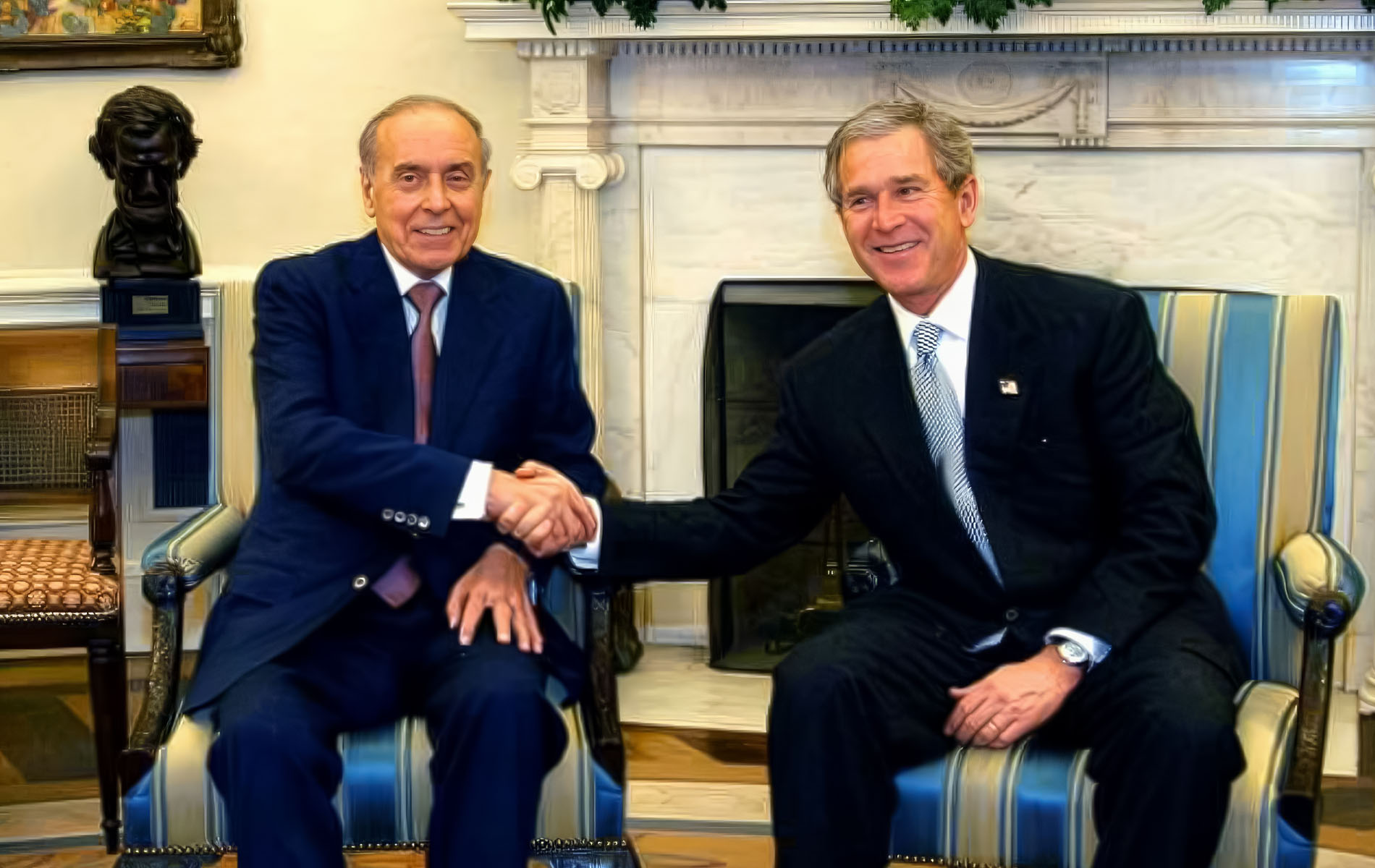
U.S. cooperation with Azerbaijan dates back to the not-so-distant past - specifically, to 1998, when Azerbaijani President Heydar Aliyev visited Washington. At that time, the U.S. Deputy Secretary of State declared that “Azerbaijan is the cornerstone of the Clinton administration’s new strategy toward the countries of Central Asia and the South Caucasus.” Back then, U.S. support for the newly independent states went hand in hand with support for Azerbaijan’s oil and gas strategy, implemented under the leadership of the national leader, Heydar Aliyev. The Presidents also endorsed the aspiration to establish even closer ties in the areas of trade and commerce, as well as the participation of American companies in the extraction and transportation of oil and gas from Azerbaijan. An agreement on the mutual protection and promotion of investments was also signed.
At the subsequent signing ceremony, attended not only by the Azerbaijani President but also by then–U.S. Vice President Al Gore and Secretary of State Madeleine Albright, the Foreign Minister of Azerbaijan and the U.S. Secretary of Energy signed the Agreement “On the Launch of a Dialogue between the Governments of the Two Countries in the Field of Energy.” Moreover, SOCAR and the U.S. companies Chevron, Exxon, Mobil, and Amoco signed contracts for the exploration and development of the prospective “Z. Tagiyev,” “Nakhchivan,” “Oguz,” and “Inam” fields. In Houston, a meeting was also held with the heads of 20 leading multinational corporations. Thus, a solid foundation was laid at that time for strategic partnership and for the successful further development of cooperation with the United States today.
