



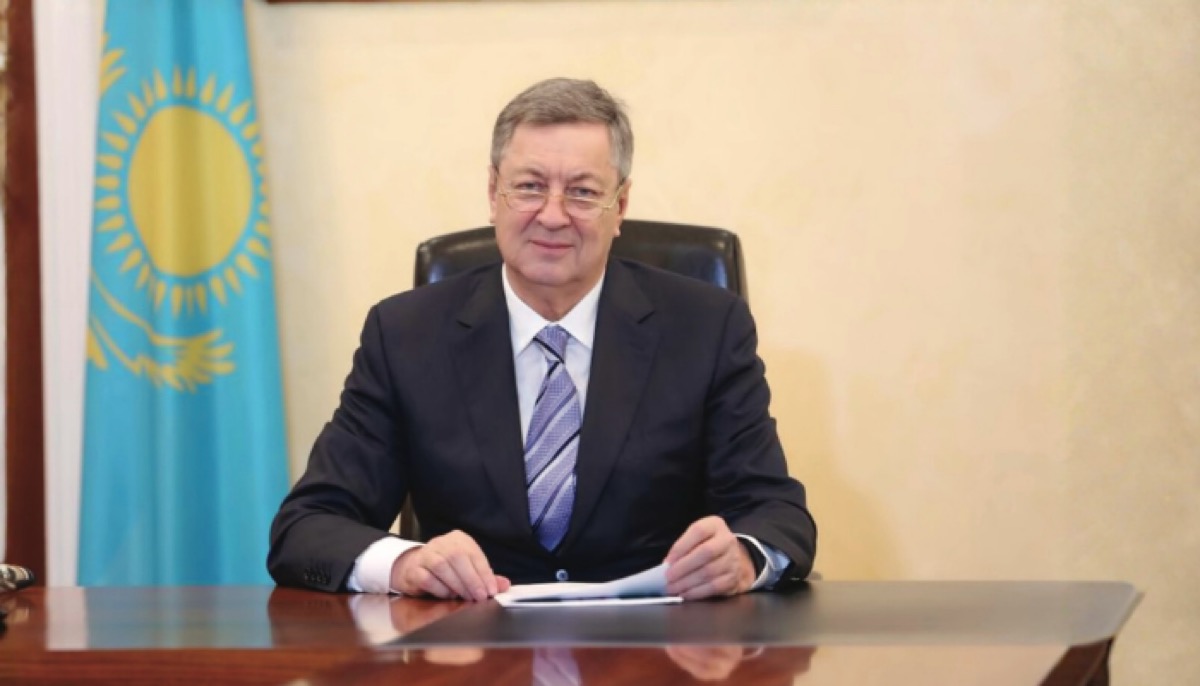
Caspian Energy (CE): What are the current priorities of the energy policy of Kazakhstan?
Vladimir Shkolnik, Minister of Energy of the Republic of Kazakhstan: Kazakhstan with its huge fossil fuels reserves, according to the World Bank, is in the list of the world’s top twenty largest producers of primary energy resources. Their total annual output comprises about 157 million tonnes of oil equivalent. In terms of oil and gas condensate, the country with its 81.8 million tonnes held the 17th position in the world in 2013.
The development of the oil-gas industry is based on a number of major projects. First of all, these are Tengiz, Karachaganak and Kashagan. The reserves of each of these fields exceed 1 billion tonnes of oil equivalent. The future build-up work is currently underway for the Tengiz and Karachaganak projects. The prioritised goal is to create a diversified system of main oil pipelines and expand the gas transportation sector. The large-scale projects, which enable to be optimistic about the future in such issues as transportation of hydrocarbons, meeting the domestic demand and ensuring supply to the fast-growing markets of our southeastern neighbors, are currently continued.
Moreover, Kazakhstan continues to ramp up gas production. In 2014 the country produced 43.2 billion cubic metres, it is 102.2% above, compared with the 2013 year. The major gas producing companies in the country are Karachaganak Petroleum Operating BV, Tengizchevroil LLP, CNPC-Aktobe JSC and KazGerMunai JV LLP.
The petrochemical industry of the Republic of Kazakhstan is developing with a focus on active deployment of brand-new technologies and solutions. Work is underway to implement investment projects that envisage creation of petrochemical productions on the basis of deepened oil and gas processing. The positive assessment of possibilities for development of petrochemical production in Kazakhstan has been proved by the results of numerous studies, including those by international oil and gas companies.
It should also be noted that since 2009 Kazakhstan has been the world’s largest supplier of crude hydrocarbons for the nuclear industry. In 2014 the republic produced 22.8 thou tonnes, and was able to meet roughly 40% of the demand of the world’s nuclear power for this strategic crude.
The Kazakhstan 2050 Strategy highlights the necessity to develop alternative, environmentally friendly energy technologies. In this regard, it stands to mention that the Republic of Kazakhstan has the extensive potential to develop renewable energy sources (RES). For example, the average annual wind speed exceeds 7 m/s in the territory of 50,000 square kilometers (2% of the country’s area). Moreover, field tests of unique wind turbines developed by the Kazakh scientists, which continue operation even in heavy windy conditions, have been successfully completed.
In 2014, 9 renewable energy projects have been finalised in the country. Their total installed capacity is 53.62 MW, including wind and solar power plants, small hydropower plants and a biopower plant.
The possibility of building the first nuclear power plant is on the agenda now. Once developed, domestic nuclear power generation will enable our country to use available fuel and mineral resources in an optimum and balanced way, to improve the export potential, to promote environmentally clean energy technologies, to develop nuclear technology for use in the various sectors of economy, to ensure social and economic development of the regions across the country supposed as areas for construction of nuclear power plants.
Kazakhstan has established industrial production of solar panels from produced and recycled raw materials. At that, the factory itself can be referred as a model for the cost-effective and high-tech approach. Energy for solar panels production is generated at the solar power plant assembled from the panels of own production. And we can confidently assert that the share of alternative and ‘green’ energy technologies will be increasing from year to year.
The prioritised goal in the energy sector is to develop the energy infrastructure of the country through implementation of the two large-scale projects on construction of high-voltage transmission lines. It is to result in creation of a balanced energy supply from the Kazakh power plants all over the country.
Please login or subscribe to read the full article.
Login / Subscribe