


Possessing rich oil and gas reserves, Azerbaijan is the cradle of the hydrocarbon civilization. Over the last two centuries the country has become an energy engine of the global industrial revolution, played a peculiar role in the victory gained over fascism. Today natural resources of independent Azerbaijan serve the interests of its people. Managing the national heritage, the State Oil Company of Azerbaijan (SOCAR) aspires to boost it by making promising investments and diversifying its business portfolio.
Baku has been famous for its oilfields since the ancient times. They were dug manually till the mid of the 19th century. A breakthrough occurred in 1846: the world’s first-ever oil well was drilled industrially in Azerbaijan on the coast of the Caspian Sea, which marked the start of the oil boom. Since then oil has become one of the main drivers of the global industrial progress.
This year Azerbaijan will produce already the two billionth ton of oil. New pipelines have been built since gaining independence which made it possible to export oil via the diversified routes. Having ensured its energy security, Azerbaijan is playing a more important role in boosting a more reliable energy security of Europe as well. The three ministerial meetings of the Southern Gas (SGC) Corridor Advisory Council with their final statements, emphasizing Azerbaijan’s role in ensuring alternative gas sources for the European market, are a vivid confirmation of this.
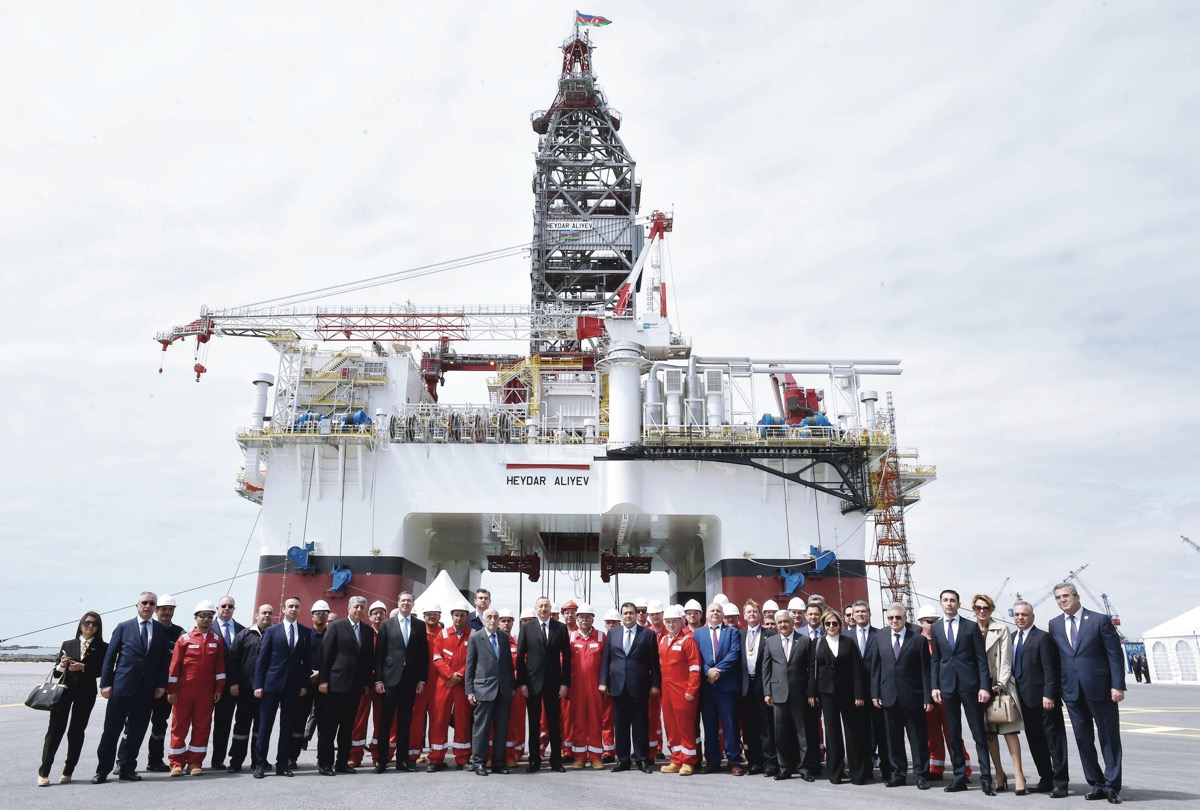
The commissioning of the Heydar Aliyev semi-submersible drilling rig - the world’s first-ever and single rig with the 1,400atm system technology - on May 18, 2017 marks the development of the oil industry and introduction of modern technologies.
The independent policy of Azerbaijan along with the active work of SOCAR in the domestic and international markets has enabled to implement numerous projects in the energy field. Timely investments into the oil refining and petrochemical industry are already yielding fruit, increasing both the company’s and the entire country’s revenues.
From the first well to modern drilling
Azerbaijan is the homeland of oil production as the oil industry takes its rise from the first well drilled in an industrial way on the Bibiheybat field in Baku. The reports signed by the viceroy of the Caucasus, prince Mikhail Vorontsov on July 8-14, 1847 confirm the fact of drilling the first-ever well in the world on the coast of the Caspian Sea in 1846. The mock-up of the world’s first oil well has been recently restored by our company and is open for all those who wish to see this historic site.
Breakthrough innovations in the oil production in the 50s of the 19th century contributed notably to the growth of production in Absheron and establishig the processing industry. The development of equipment and technology for mechanical drilling of wells enabled to commission a number of new oil fields in Baku, to drill wells and to increase oil production rates. In 1899-1901, the oil industry of Baku, which used to produce 11.5 million tonnes of oil, ranked the first in the world. For comparison, please note that in the United States of America, which started drilling oil wells in an industrial way in 1859, this figure at that time was 9.1 million tonnes. On March 28, 1971, the billionth ton of oil was produced in Azerbaijan. The output up to the present day has comprised 1 billion 971 million tonnes of oil (1 billion tonnes at sea, 971 million tonnes on onshore fields). This year Azerbaijan will bring the total oil output to 2 bln tonnes. Besides, up to the present day the Azerbaijani oilmen have produced 700 billion cubic meters of gas.
“Oil is our natural wealth and the great asset of our people. We chanell oil revenues to the development of our country, invest them in human capital and infrastructure projects”, President of Azerbaijan Ilham Aliyev said on April 26 2017, viewing the state of the world’s first-ever industrially drilled well after recovery, and called it an historical event.
In the 1970s and 1980s, the initiative of the National Leader, Heydar Aliyev enabled to bring ‘Shelf’ drilling rigs to the country. In the years of independence they were reconstructed and such floating drilling rigs as ‘Dede Gorgud’ and ‘Istiglal’ were built. Later a reconstruction was carried out at ‘Dede Gorgud’ and ‘Istiglal’ semi-submersible drilling rigs and the opportunity to perform drilling operations in the open sea with the water depth of 700 meters was created in order to carry out exploration and drilling operations in deepwater areas. At the same time ‘Lider’ drilling rig built in 2000 enabled to drill wildcut wells on sites where the water depth is up to 1,000 meters.The next stage of this process marked the opening ceremony of the Heydar Aliyev semi-submersible drilling rig which took place on May 18 2017 and was attended by President of Azerbaijan Ilham Aliyev.
The funds invested by both the State Oil Fund and the State Oil Company in implementation of this project comprise approximately $1 billion. This rig is unique in terms of its technological characteristics and drilling features, including the large automatic control system. The total weight of the rig is 26,000 tonnes. Drilling can be carried out at the sea depth reaching up to 1,000m. The maximum depth of the well can reach 12.2 thousand metres. In addition, drilling operations are performed 4 times faster than those performed by drilling rigs of the previous generation. The Heydar Aliyev semi-submersible drilling rig is the world’s first-ever and single rig with the 1,400atm system technology. This drilling rig is planned to be operated at the very promising Absheron gas and condensate field.
In the meantime, works are underway on the Umid field. Foreign companies again show interest in such projects as ‘Babak’ and ‘Karabakh’. At the end of the last year SOCAR signed two more important documents: SOCAR and Total entered a Framework Agreement on the principles governing the development program of the Absheron project, a Letter of Intent on the principles of the agreement on development of the Azeri-Chyrag-Gunashli oil field until 2050 was signed with BP.
According to the first document, geological exploration and drilling operations are carried out at the Absheron gas and condensate field, technical and economic performance of the field is being assessed and the work program for a start of production is being prepared.
The second document covers the development of Azeri-Chyrag-Gunashli (ACG) until 2050, which will significantly increase the potential of the block until the middle of the century. At present, the daily oil output at ACG is about 580,000-600,000 barrels. The Letter of Intent envisages the main commercial principles of future development of ACG and creates prerequisites for the parties to complete negotiations and approve final conditions in comings months.
Successes at Umid (200 billion cubic meters of gas and 40 million tonnes of condensate) and Absheron (350 billion cubic meters of gas and 45 million tonnes of condensate), as well as gas reserves in the deep-lying horizons of the Azeri-Chyrag-Gunashli and others, enable us to suggest that by 2025 commercial production of gas in Azerbaijan can reach 40 billion cubic meters per year.
From feedstock to finished products
Relying on the rich resource base, SOCAR staked on broad-scale investments into the oil and gas processing, as well as on the petrochemical industry. Aspiring to diversify investments and integrate the value chain, the Company has adopted this strategy several years before the start-up of crude oil price fluctuations. At the same time, the prospect of diversification of the business portfolio is becoming more evident under changing market conditions. For instance, the price for petrochemical products fell to a far lesser degree amid a crude oil price decline. In recent years Turkish Petkim enterprise, managed by SOCAR, has reached a record growth of profits. Thus, in the first quarter of 2017 alone the net profits of Petkim increased by 141% and reached 359mln TRL vs the figure of the same period of last year.
The strategy of development of the petrochemical complex includes projects on upgrading of the Heydar Aliyev Oil Refinery, construction of the STAR oil refinery, SOCAR Polymer, SOCAR Carbamide and SOCAR GPC plants.
The capacity of the crude oil distillation unit and the catalytic cracking unit, operating at the Heydar Aliyev Oil Refinery, is planned to be increased from 6 to 7.5 million tonnes per year and from 2 to 2.5 million tonnes per year respectively. The main objective of modernization is to obtain fuel (petrol and diesel) meeting the Euro-5 standard. Sulfur processing unit, sour water stripper, Merox unit for LPG production, as well as an amine scrubber are planned to be built in the course of the stage-by-stage modernization. The major stages of modernization of the plant is planned to be completed by the end of 2020.
Construction of the polymer complex of SOCAR Polymer holds a special place among petrochemical projects. The major goal of the project is to monetize oil refinery associated gas. High density polypropylene and polyethylene will be basic products of the complex which creates a feedstock for production of consumer products by small and medium enterprises, envisaged in the Sumgayit Chemical Industrial Park, on favorable terms. The commissioning of polymer plants is planned to start from 2018. Investments worth $750mln will bring revenues worth about $10-11bln 30% of which will fall to the share of net profits. The products will fully meet the domestic demand. Up to 70% of SOCAR Polymer products can be exported. Production capacity of the polypropylene and polyethylene plants will reach 180,000 tonnes and 120,000 tonnes per year.
A number of important documents, including agreement on SOCAR GPC project, were inked between SOCAR and its partners (CNPC, CDB and Technip) at the forum hosted in Beijing within the framework of “One Belt, One Road” strategy. SOCAR GPC project envisages processing of natural gas and gas condensate produced in Azerbaijan, polymerisation of C2+ fractions, as well as production of gas-chemical products. The new project implies construction of the gas processing and gas chemical plants, assembling of relevant units, as well as offsites to secure maintenance of these plants and units.
Construction of the carbamide plant in Sumgayit is expected to be ended late in this year. Full commissioning of the plant is scheduled for the next year. SOCAR Carbamide will fully meet the demand for fertilizers in Azerbaijan, set aside the necessity of import and broadly promote the export potential. The plant with a total area of about 40 hectares will consist of units for ammonia, carbamide production and granulation of carbamide. Natural gas will be used as a major raw material for production of nitrogen fertilizers. Gas consumption for production is expected to total 1.32 million cubic meters per day and 435 million cubic meters per year. Daily production capacity of the plant will make 1,200 tonnes of ammonia and 2,000 tonnes of carbamide. Implementation of the project will also benefit the national agriculture. The plant will produce about 650-660,000 tonnes of carbamide per year, which fully meet the domestic need. Along with this, products are planned to be exported to the world markets by railway via the Turkish and Black Sea ports. Total cost of the project makes about 750 million EUR.
SOCAR is extending its presence in many countries, starting mainly from neighbor states. Georgia was the first country that SOCAR invested in. Now SOCAR is the biggest tax payer in Georgia.
SOCAR’s largest overseas investment program is being implemented at the Turkish market. Star Oil Refinery is planned to be commissioned in the next year. Reducing the petrochemical sector’s dependence on import, this project will let Turkey maintain annually exchange reserves at the amount of up to $2.5 bln. Annual income is forecasted at $600mln which will provide Azerbaijan multibillion profits in coming years. Our plans in Turkey are broad-scale. TANAP pipeline will be built till 2018, so will be the container port in the west of Turkey. SOCAR is also expanding its presence in other countries and continents. In particular, noteworthy is the significance of the Southern Gas Corridor project designed to ensure to access for Azeri gas to the Turkish and European markets, thereby making significant contribution to the energy supply and energy security of the region.
In general, the current status of SOCAR at the global energy market can be characterized as a fast-growing transnational operating energy company. Holding leadership in Azerbaijan, the homeland of oil production, SOCAR keeps successfully fulfilling the mission it has been assigned. Multiplying the national heritage of the country, the Company is strengthening its export potential and giving a boost to its sustainable development. Focused on petrochemical complex, the company continues broadly unlocking the potential of oil and gas not only as a fuel but to a larger extent as important resources for the polymer industry and agriculture which are capable of making significant contribution to the sustainable development of the world economy and ecology.
