



“We must leave oil, gas aside and even forget them. One day oil prices will bear no significance for us”, President of Azerbaijan Ilham Aliyev stated at the opening ceremony of a modern tourist complex of Azerbaijan which took place at the height of the price crisis at the oil market. It in fact means a lot if the President of the country, which is the land where the first ever onshore well was drilled in mid of the 19th century, where for the first time ever offshore oil production kicked off in 1954 and the oil contract of the century was signed in 1994, speaks about the end of the oil era. Will Azerbaijan manage to turn the course of the history back– the scope of tasks is immense and speaks for itself.
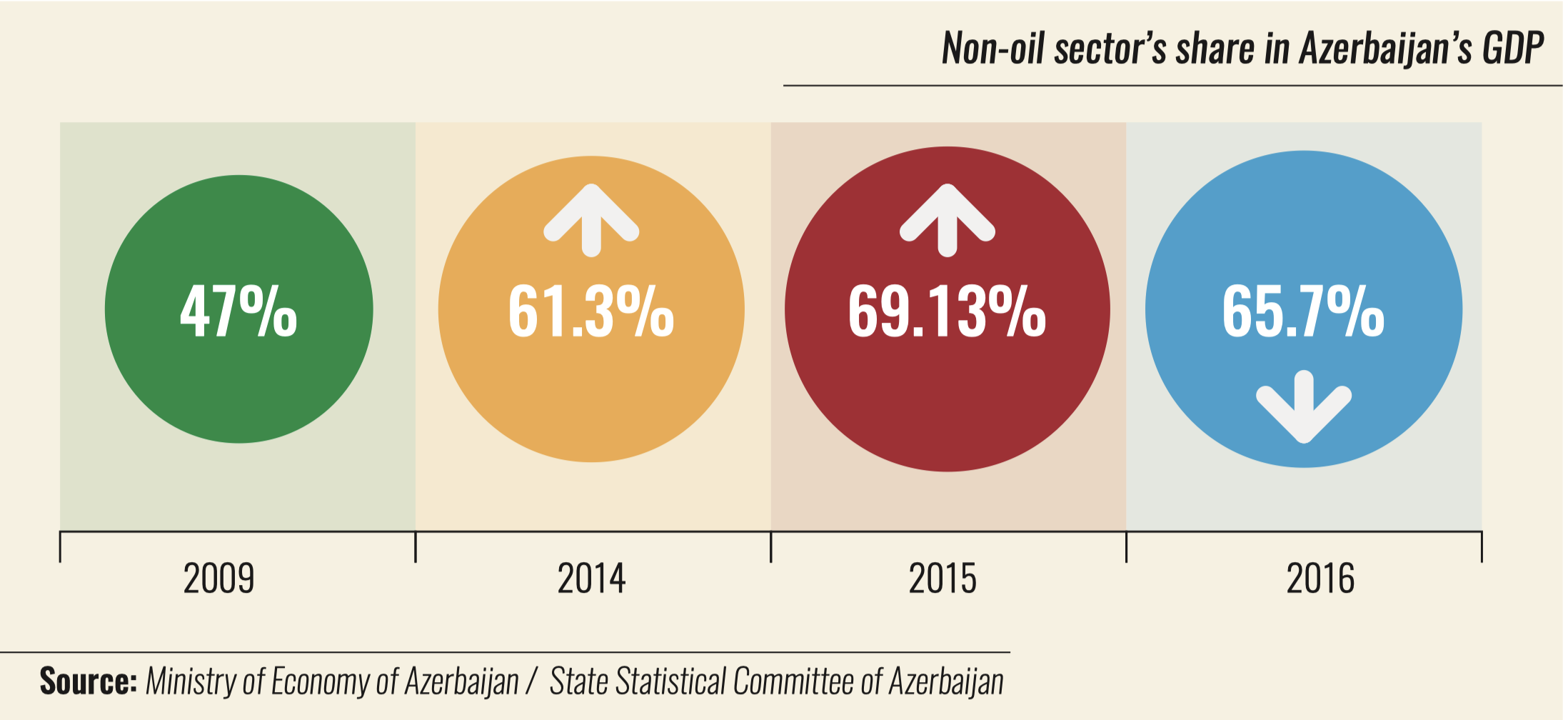
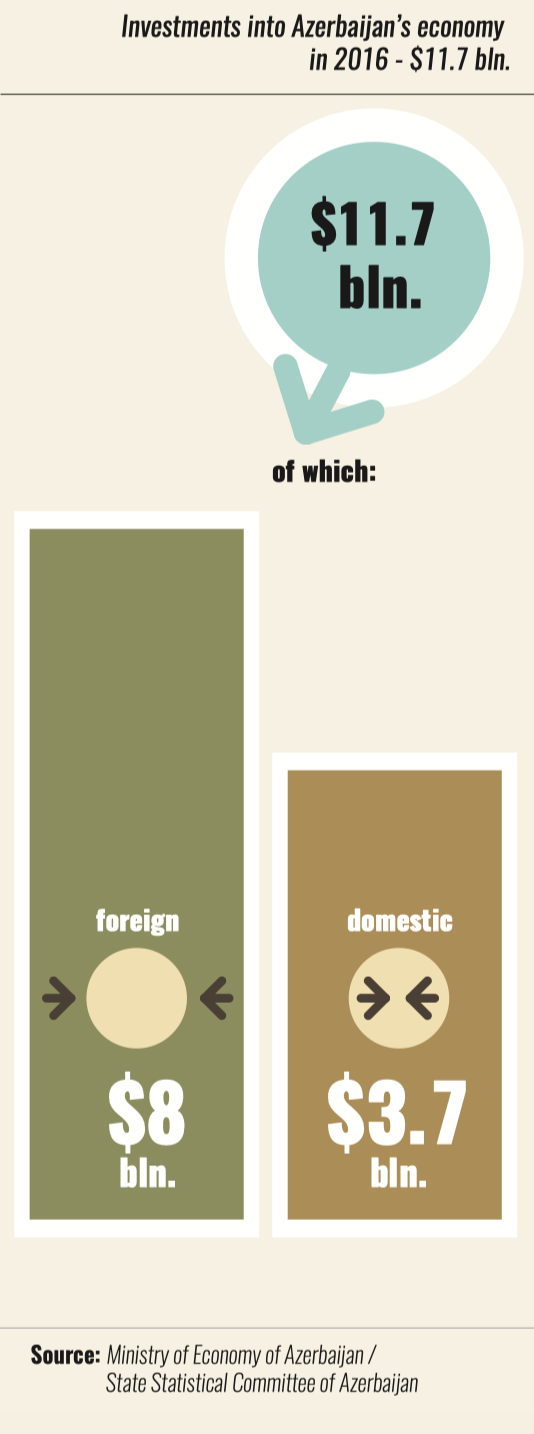
Azerbaijan has felt the bite of the unparalleled crisis of the world oil market prices that has been lasting for more than 2 years. Despite the non-oil sector’s share in GDP is growing year by year the revenues of the state budget are still firmly tied up to the oil export. Non-oil sector’s GDP totalled 47% in 2009 while this figure made 61.3% in 2014 and 69.3% in 2015. According to the data of the Ministry of Economy, it is mainly the non-oil sector which has contributed to the GDP growth in recent years. The non-oil sector is also ahead in terms of the rate of attracting investments. Investments worth $20bln flew into the Azerbaijani economy in 2015, the share of the non-oil sector comprised $10.2bln.
At the same time the share of crude oil is still considerable in total export of Azerbaijan though it is falling due to the decline of export volumes. This figure totalled 76.15% in January-June 2016 vs 77.61% of the last year, 84.32% in 2014, 84.44% in 2013, 84.6% in 2012, 86.62% in 2011 and 86.53% in 2010. Along with the declining trend of the world quotations it negatively impacts the export-import operations and balance of payments, causing state budget deficit and GDP decline.
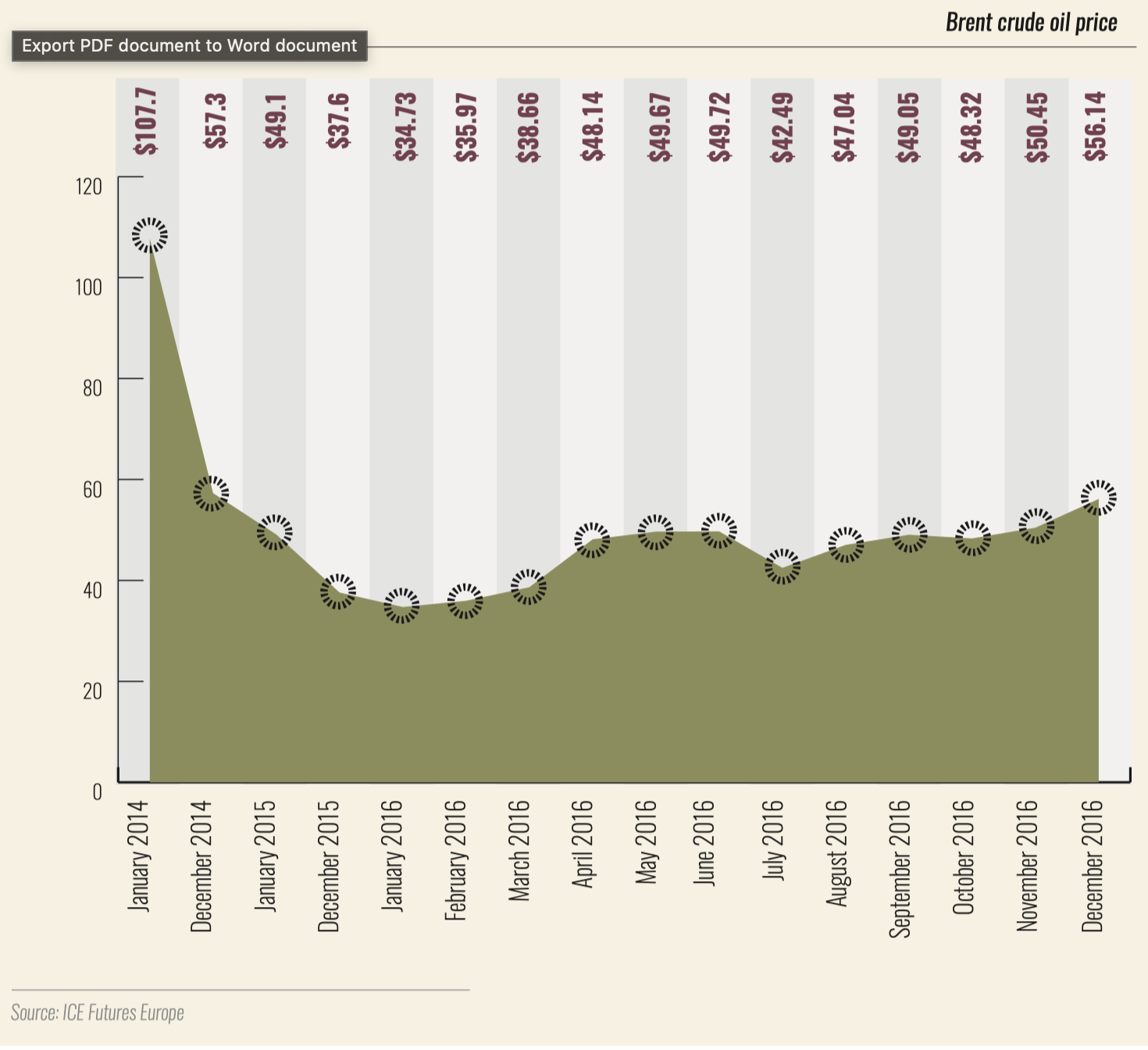
Brent crude oil price averaged $107.7 per barrel in January 2014 while this figure totalled $57.3 per barrel in December, $49.1 per barrel in January 2015, $37.6 per barrel in December 2015. Brent price fell down to $34.7 per barrel in 2016. The price totalled only $56.1 per barrel by December.
However, the decline of export along with the fall of prices at world markets have quickly revealed the weak sides and activated reserve mechanisms aimed at diversifying the Azerbaijani economy.
‘Weak link’
Altogether two devaluations have crashed the national currency (manat) by 97.5% percentage points. Owing to reserve funds saved up in fat oil years by the Central Bank and Oil Fund, the rate was kept stable for half a year of the crisis. In a situation, when the neighbour countries’ currency rates declined, the need for devaluation aimed at maintaining currency reserves and lowering the pressure on national export seemed to be a forced step taken by the Central Bank. If one looks at the oil quotations, it is namely this period when oil prices decreased down to their annual minimum. The first devaluation (February 21, 2015) has lowered the manat rate by 35%. Almost a year later (December 21) the rate fell by another 55%. The following negative processes have shaken and in certain cases destroyed the balance of the formed credit-financial system of the country. Licenses of a number of local banks and insurance companies were withdrawn. The population lost the trust in the private banking sector. In general, depositors of 10 closed banks received compensation at the amount of over 700ml manats.
Therefore, Financial Market Supervisory Authority (FIMSA), established in March 2016, urgently started working over several draft bills aimed at developing financial market infrastructure, Chairman of the Financial Market Supervisory Authority Rufat Aslanli said. “One of them is the draft bill on “Registration of pledge on immovable property”. This draft bill is to promote the establishment of the institute which will be able to ensure easy, cheap and free access to the financial infrastructure, especially to credits. The work over the draft bill, reflecting loan security provision, will be launched in the near future”, R.Aslanli said. FIMSA has revealed that the legislation implies a temporary administration but the law “on banks” does not mention which exact operations a temporary administrator can perform. According to new changes in the law, if any certain bank loses its solvency or faces capital insufficiency, an administrator will be able to sell its assets to other banks by means of auctions and spend the gained funds gained on the bank’s recovery. Another option implies creation of a so called ‘transition bank’ which assumes obligations and assets of the troubled bank and is going to be sold to sound investors afterwards. In essence, these changes will help to apply a global practice to recover the banking sector, R.Aslanli says.
However, the head of FIMSA did not say who is going to be a ‘sound investor’ – stabilization fund, a foreign bank or an international financial structure. Is there a need to apply such a global practice of recovery when Azerbaijan’s state debt makes no more than 20% of GDP and it still has a chance to grow while in suffering European countries this figure was critically higher at the time of the debt crisis – Greece 169.1% of GDP. Italy (133.3% of GDP), Portugal (131.3%) and Ireland (125.7%) have shared the following positions respectively. According to the Maastricht agreement, the state debt of the eurozone member country must not exceed 60% of GDP. Who is there to be rehabilitated if the ‘weak links’ have already been revealed, licenses have been withdrawn, the state has kept its reserves just as well as it chose not to increase its debt by saving 10 private banks accused of currency speculations at the domestic market, thus further aggravating the crisis. Would not it have been better to have the struggle against these negative processes as the cornerstone of the crisis handling efforts given the state good-looking macroeconomic indicators? For instance, a special tax on big financial transactions could have been imposed to prevent speculators from quick converting money from one currency into another and thereby playing against the national currency and causing devaluation. It was the very measure applied in the EU when it was clear that attacks of speculators indeed had a serious impact on the trend of events in the eurozone and that chaotic withdrawal of big capital from certain countries or economic sectors can crash the financial system of small states.
At that, the size of the European Financial Stability Fund totalled € 750bl. Currently it has been considerably increased. Within the framework of the long-term measures of stability it was offered to create the European Treasury for Control over Budgets of the Eurozone Countries, and to reform the Stability and Growth Pact in terms of streamlining criteria and automatic punishment of violators. These measures cause resistance because of reduction of the national sovereignty of the Eurozone countries.
Growth drivers
Will the economy, which is living through a slowdown, be able to serve its debt portfolio of financial liabilities given that in 2016 Azerbaijan’s GDP comprised 59 billion 987.7 million AZN (down 3.8% vs. the similar indicator of 2015), although a year earlier the GDP growth rate stood at around 1%.
The government believes that yes, it will do and even export investments to Turkey, Georgia, Ukraine, Romania, Moldova and other countries. Public and private companies of Azerbaijan are actively involved in projects in the fields of petrochemicals, logistics, infrastructure in foreign countries, the Economy Ministry said.
Cheap loans (for example, a 10-year loan with a preferential interest rate from Gazprombank for the construction of a petrochemical complex), easing of the investment regime and privatisation of a part of state property will be required to ensure economic growth and implement new industrial projects. According to the decisions for the business sector, which President Ilham Aliyev adopted under the package of economic reforms, inspections of businesses have been frozen for 2 years, the areas that require licensing have significantly reduced in number, customs procedures have been simplified, Boards of Appeal have been established and measures to encourage investment have been implemented.
Also, in accordance with the Decree of the President, with a view to boost entrepreneurship and create favourable conditions the scope of activities that require obtaining government licenses has been significantly reduced, while remaining licenses have become perpetual. State fees for obtaining licenses have been decreased by 2 times and 4 times in the regions. Licensing procedures have been simplified as well.
“270 industrial companies opened in 2015 only. Construction of a number of industrial facilities is currently underway”, Minister of Economy Shahin Mustafayev says. At present, relevant work is underway in the Sumgayit Chemical Industrial Park, Balakhani, Garadagh and Mingachevir industrial parks, Pirallahi and Mingachevir high-tech parks and Neftchala Industrial District.
It worth mentioning that the construction of the Neftchala Industrial District has already been completed and relevant works to install necessary equipment are currently underway in the industrial district. Currently, operations on 8 projects are being implemented in the industrial district. In August 2016, the groundbreaking ceremony for a joint Azerbaijani-Iranian car manufacturing plant was hosted at the Neftchala Industrial District. The plant is the joint project of the Azerbaijan company AzEuroCar and the Iranian company Iran Khodro. The total project cost is 22.5 million AZN.
6 residents have been registered in the industrial quarter, and 3 of them will have started working before the end of this year. More than 500 new jobs will open once projects are implemented.
Though the Sumgait Chemical Industrial Park was established in a short period of time, currently 9 companies have received a status of a resident. The size of investment attracted on the basis of the projects of these residents is to exceed $1.1 billion and more than 2,000 new jobs are to be created.
Within the Balakhani Industrial Park, which is the first industrial park in the sphere of waste recycling in the region and is of paramount importance for the development of “green business” across the country, there are 5 registered residents specializing on recycling of used motor oil, tires, plastic utensils and printed graphic arts products. The total size of investment comprises 23 million manats and 300 new jobs will be opened in the framework of implementation of projects.
As for the Garadagh Industrial Park, $470 million has been already invested in this park and this will enable to increase the number of permanent jobs to 2,000. The Baku Shipyard, which is the resident of the Garadagh Industrial Park, has fulfilled the order worth $40 million and is currently implementing projects in the field of underwater construction and construction of 3 passenger ships.
The Mingachevir Industrial Park will operate in the field of textile industry and organizational activities are currently underway to make the park operational. The unnecessary facilities around the park have been already demolished and preparation for a start of construction work has been finalized. On September 21, 2016 President of Azerbaijan Ilham Aliyev attended the groundbreaking ceremony for the Mingachevir Industrial Park. Nine factories for production of fabrics, clothes, carpets and other products of light industry are planned in the industrial park. According to the preliminary estimates, more than $200 million will be invested in the Mingachevir Industrial Park and more than 5,500 new jobs will be created.
At the same time, according to the Decree of the Head of State, work is underway to create the Pirallahi Industrial Park. Creation of the park is vital in terms of pharmaceuticals production, reducing the country’s dependence on imports and promotion of domestic production in this area. It should be noted that at the first stage investment into the two projects for pharmaceuticals production will comprise up to $90 million, thus opening up to 300 new jobs. The project will be implemented jointly with the Russian and Iranian companies.
But perhaps the most important project for development of the transport and logistics infrastructure is located in Alyat settlement, Garadagh district, covering the territory of the new Baku International Sea Trade Port. Here, work is underway to create a special economic zone like a free trade area. Recently, the Ministry of Economy and DP World group of companies (Dubai Port World - one of the world’s largest port operators) have signed an agreement for the provision of consulting services for creation of a free trade area (FTA) in the Alyat settlement. Efficient use of the capacity of transport corridors passing through Azerbaijan will increase the share of this sector in the non-oil sector in the future. To this end, the Coordination Council on Transit Freight has been established and work on development of the North- South international transport corridor has been accelerated. Construction of the bridge over the Astara River, as well as a 8.3-km section of the railway in Azerbaijan, which are the most important parts of the North-South international transport corridor, has already been completed.
Once completed in the near future, the work should increase the share of the non-oil sector in the total GDP and reduce the dependence on the oil factor to a minimum, according to the Ministry of Economy. These projects will be only a part of a larger plan for development of almost all sectors of economy, where an export component is feasible – cotton production, tobacco growing, development of the IT technologies.
