



“As we used to do in the old days”…
Сonsidering Donald Trump’s activity from the economic point of view, it can be noticed that he did not put the matters of hegemony, gigantomania and “arm-twisting” for objectionable regimes at the top of his presidential campaign, but economic interests. His motto “Make America Great Again” was echoed by millions of people. Oddly enough, his economic agenda, which was more like a large-scale pr-campaign, is being realized now.
Figures of main stock indexes indicate the mentioned as well. However, they can also mark a descending trend at any moment, but it has not been observed yet. So, NASDAQ Composite, including over 3,000 American and non-American corporations, is a step away from 5,800 points which is a historical maximum. Dow Jones reached 20,602 points in mid of February of this year, though, as early as November it varied around 18,000 points. S&P 500 reached 2.340 in mid of February. Total capitalization of S&P 500 makes over $20 trillion. Russel 2000 which also renews historical maximums reached almost 1,400 points in February. According to the results of the trading held on February 16, after the US elections Japan’s key index Nikkei 225, which includes big Japanese mega-corporations, increased from 16,900 up to 19,200.
By all appearances, the energy revolution along with the industrial revolution in the United States is gaining momentum. Anyway, his first executive orders testify that. During his first week in office Donald J. Trump signed the executive orders aimed at revitalization of Dakota Access and Keystone XL crude oil export pipelines and involvement of US producers in them. It is a great event in the oil-gas industry and speaks a lot about further actions of the US President because the previous administration had been holding talks on these projects for 7 years and finally turned them down in November 2016 as “mismatching the US national interests”. The negative environmental impact and insufficient economic benefits were named among other reasons for their failure.
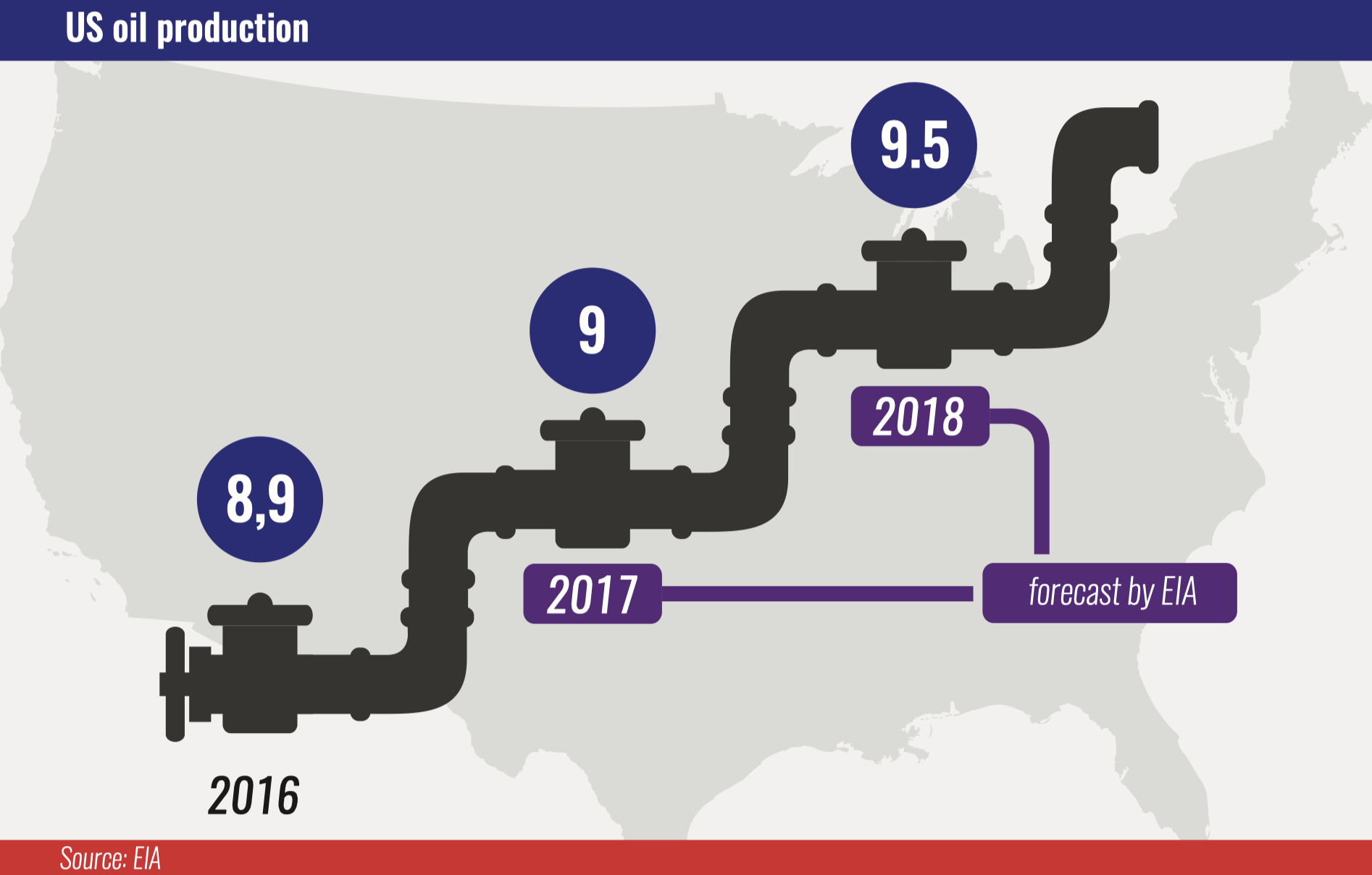
Shale oil and gas reserves, either abandoned or previously inaccessible to old production technologies, as well as onshore and offshore oil, gas and coal fields with the total forecasted cost of about $50 trillion will be used under the energy revolution. Donald Trump intends to create up to 1.5 million new jobs annually with the payroll budget of up to $30 billion.
“It will be difficult and take time to create an appropriate infrastructure”, Trump said. “But it will give jobs back to thousands of steelworkers. We will build our own pipeline. We will build our own pipes as we used to do in the old days”.
“Rust Belt” or “new belt”?
What is going to happen to the United States in the coming years either a revival of the steel industry and the so-called “Rust Belt” with it, or high technologies and an entirely new industry? Yet there is no answer to this question, but financing has already been found for it. Like his predecessor, Donald Trump proposes to consider favorable terms for American businesses to enable them to repatriate their funds from abroad. At present corporations have trillions of dollars parked overseas to avoid the 35% tax rate. This is about a flat 15 percent tax. This money will be re-invested in such states like Michigan”, Trump promised his election campaign in Detroit. He claimed the city will return to prosperity only if the United States develops the industry. The current level of oil and gas production in the country boosts such plans, but it is contrary to the own export policy of the United States.
Since the development of industry and its future competitiveness on world markets will need cheaper energy resources compared to global energy prices, the present Administration may be tempted to restrict export of hydrocarbons during peak demand in the domestic market. There is also a flip side of the growth – it is the increase of competitiveness, high probability of domestic market regulation (like in the EU), certain isolation (that may be caused by the dumping policy declared by the President) which usually makes the position of the unit of the national currency stronger and this is not profitable for exporters. All these facts can lead to the negative moments in the economy such as deflation, stagnation, economic growth and as a result to further a much higher budget deficit, overregulation of the economy and the crisis similar to the situation in Japan observed during the last few years when the national financial regulator had to bring the base lending rate down to zero and later introduce a minus rate.
In order not to avoid it the United States will probably have to balance ‘old habits’ with new habits’ that President has had at his disposal for long time and are also highly developed in the USA, staking mainly on science-intensive digital technologies and environmentally clean super-high cycle production driven by cheap energy resources. In Europe it is the so called Industry 4.0, which as a matter of fact can make the declared ‘energy revolution’ “peaceful” and long-term enough especially since the basis of this balance is already available.
For example, Texas has always been the oil state, but suddenly it has become a leader in renewable energy, especially wind power. Solar energy production is gaining momentum in Texas and prices for solar panels are falling constantly there. Jennifer Ronk, a renewable energy expert at the Houston Advanced Research Center, said the use of coal is likely to decrease more and more in the coming years in Texas and other locations, mainly because of cheaper and cleaner natural gas burning. Enel Green Power North America, Inc. (EGPNA) has started construction of the Rock Creek wind farm, the first Enel farm to be built in the state of Missouri. Once fully operational, Rock Creek is expected to generate approximately 1,250 GWh annually – equivalent to the energy consumption needs of more than 100,000 U.S. households – while avoiding the emission of about 900,000 tonnes of CO2 annually.
Rock Creek is one of six Enel renewable energy projects currently under construction in the United States, together with the 108 MW Drift Sand wind farm in Oklahoma, the 400 MW Cimarron Bend wind project in Kansas, the 150 MW Lindahl wind project in North Dakota, the 65 MW Chisholm View II wind project in Oklahoma and the 150 MW Aurora solar power project in Minnesota.
How will flourishing oil and gas upstream and alternative energy manage to share the US market, what is going to be the US export policy which also directly depends on Canadian producers (Where Donald Trump’s energy program leads? http://www.caspianenergy.net/en/investor-en/37254-trump) and NAFTA’s free market conditions, how much energy will be necessary for development of industry and how will it affect the structure of exports? Currently, the situation on global oil markets and principles of international trade for the coming decades largely depend on how these issues will be addressed.
The way these factors will impact the Caspian region and Caspian countries is not clear yet as the US President Donald Trump made no statements concerning a stance, character and level of cooperation with certain Caspian countries and has held no meetings with the leaders of these countries yet.
But still, there are real positive processes of economic integration and cooperation, as well as trade revival observed in the Caspian at present. All this is associated both with the Caspian status problem which is close to finding a solution at the coming Astana Summit, and comprehension of the real commercial viability of building modern business system of interregional cooperation in energy, transport and financial sectors, as well as well in small and medium business.
Therefore, the new US administration, which realizes problems of the business and oil-gas sector from inside, arises sympathy in the region. And even the loudest political statements of the charismatic American President will not be perceived unambiguously there as it used to be admitted as a signal to confrontation in the Caspian and Persian Gulf before.
It seems that Baku, the only capital of the Caspian state and center of all interregional strategic energy and transport projects, is especially interested in multilateral cooperation with the United States.
