



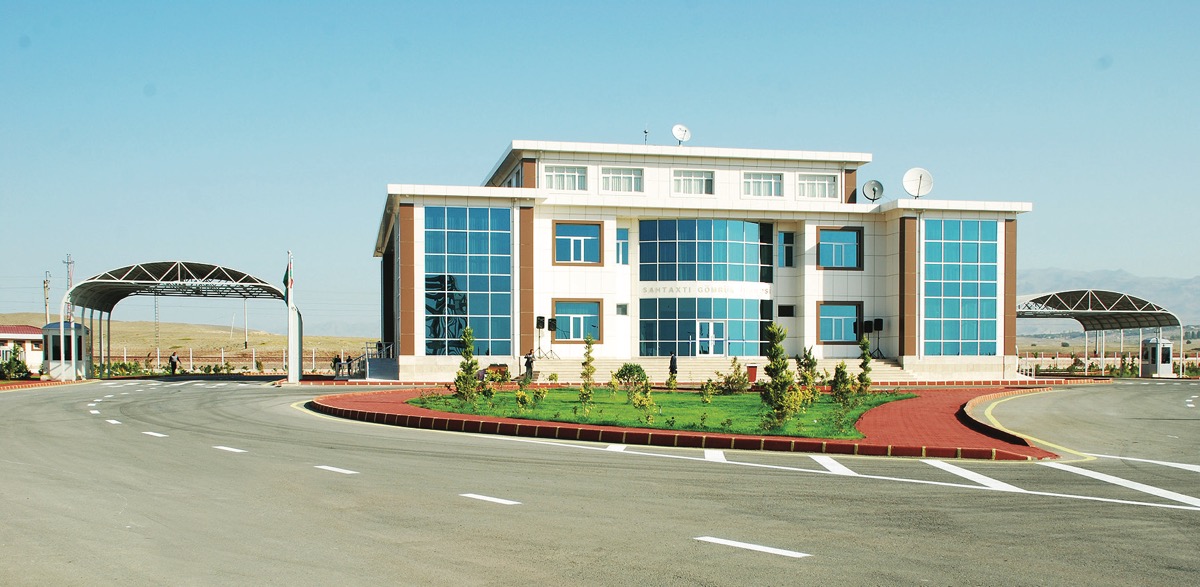
The customs service plays an important role in ensuring the economic security of the Nakhchivan Autonomous Republic. The measures taken to perform fiscal functions, fight against offences in the customs field, ensure efficient organization of the external trade and protection of the domestic market are the main lines of the activity of the customs bodies. The peculiarities of Nakhchivan are taken into account while implementing the customs policy of this region, which promotes a general development.
As a result of the overall attention and care of the state, the customs service of the Autonomous Republic possesses a modern infrastructure and a strong material and technical base. The customs complexes, the Nakhchivan Customs Examination Department and the Customs Laboratory were established in Julfa and Shahtakhti in 2007 and 2009 respectively. Considering international standards and local conditions, the customs complexes, the Nakhchivan Customs Examination Department and the Customs Laboratory established for the customs agencies of Nakhchivan cities in 2012, an administrative building for the Nakhchivan Customs Department for Air Transport which was commissioned in 2014, as well as a new administrative building and warehouse facility which were built and commissioned for “Nakhchivanterminalkompleks” association in 2015, comply with the highest standards.
At present, all the border-entry points, the entire customs system together with its modern infrastructure and strong material-technical base are reflecting dynamic development, progress and modernization reached in Nakhchivan. In other words, foreign guests arriving into our Autonomous Republic, people using the customs services while entering into our land, witness social-economic development of the modern and attractive region through the border-entry points. A modern complex which is underconstruction for the Sadarak border-entry point, Nakhchivan’s window to Europe, at a territory with an area of 18 hectares, combines all the parameters of the modern customs concept.
Along with the ongoing infrastructure and structural reforms, granting the international status to the Shahtakhti-Poldasht border-entry point, launching around-the-clock operation at Sadarak and Julfa customs border-entry points, as well as a 12-hour working schedule at Shahtakhti customs border-control point, serve as a visual indicator of the overall development of the customs business.
Development of relations with neighbor countries, reorganization of the road-transport infrastructure, creation of the modern customs infrastructure, simplification of the customs procedures create opportunities to demonstrate a transit potential of Nakhchivan.
Owing to a big attention and care of the state, the most advanced standards are currently applied in the customs system of the Autonomous Republic. X-ray machines, installed and used at Julfa, Shahtakhti and Sadarak border-entry points, make it possible to carry out a more full-fledge and faster customs control over cargoes and cargo vehicles arriving into the Autonomous Republic from different directions.
It is noteworthy that this equipment, produced in Germany, is the most modern one applied just in a few developed countries of the world. Of course, the use of one or another high-tech equipment in the course of work along with doing an important job to prevent smuggling cases, develop external trade, facilitate import-export procedures, and enhance the quality of the customs activity in general, also stimulates organization of services on a high-level.
The range of using of information-communication technologies in the customs system and the area of e-services is getting wider year by year in order to simplify documentation, ensure transparency and activate customs-business cooperation. Customs registration and customs inspection of goods and vehicles crossing the border is carried our through a single electronic system in accordance with the “one-stop-shop” principle.
The Unified Automated Control System (UACS), created within the framework of the modernization of the customs services, is at a stage of shifting to digital technologies. At present, the data exchange, operating procedures and payment operations are being performed on basis of the electronic technologies.
The procedures associated with the entering of goods by the customs bodies are very simple. Without visiting a customs point, citizens can submit online information about goods and transport facilities they are transporting through the customs border. Besides, a prior submission of brief import or export declaration makes it possible for physical and legal individuals to inform the customs bodies about an external-economic activity they carry out, and ensures a fast passage of goods and transport facilities via the customs control.
Along with the customs control, the registration of imported goods and transport facilities is also carried out by using international standards. The use of the automated risk management system in the customs field increases the efficiency of the customs control. A “Green corridor” system and other entry systems, existing in the international practice, are used to transfer goods and transport facilities across the customs border.
This, in its turn, substantially facilitates the work of entrepreneurs. In such conditions, the customs control and registration are carried out faster and without any loss of time. It is no coincidence that when a person, involved in external economic activity, prepares and submits documents in accordance with the requirements of the customs legislation, it takes 5-10 minutes to complete the registration process.
Sanitary and quarantine protection in border-entry points of the Autonomous Republic is also arranged in accordance with modern standards. Necessary preventive measures and disinfection operations are performed in order to prevent the spread of infections and dangerous viruses registered abroad and especially in neighbor countries.
The customs bodies find the protection of the domestic market one of the priority lines of their activity. The work carried out in this area prevents leakage of currency abroad, ensures employment and creates favorable conditions for a sustainable development of the economy. The measures, taken by the customs bodies to protect the interests of local producers and stimulate the sale of local products in the domestic market, give an additional incentive for not only solving the food supply security of the Autonomous Republic but also increasing its export potential.
The domestic market is protected by the legislation-based tariff and non-tariff measures taken towards goods imported from abroad and affecting local production. Constant control over the protection of the domestic market from cheap and low-quality products and protection of local goods capable of meeting domestic needs are carried out together with the relevant public agencies.
The customs bodies also maintain a tough control over the quality of imported goods. The customs laboratory operating under the Nakhchivan Customs Examination Department plays an important role in ensuring food supply security of the Autonomous Republic.
A dynamic development of the economy has a positive impact on the expansion of external trade relations. Today, operations are performed with more than 50 countries of the world. The annual increase of the range of countries in export operations peformed within the framework of the external trade turnover, as well as the growth of the export assortment have been important innovations. According to statistical analyses, nowadays, the industrial and agricultural goods account for 79% and 21% in the total export volume of the Autonomous Republic. Of course it indicates a big economic potential of the Autnomous Republic.
It is also noteworthy that a dynamic social-economic development, expansion of trade relations, strengthening of the customs infrastructure and material-technical base also create favorable conditions for expanding relations in the field of the international cooperation. The existing mutually beneficial relations of the Nakhchivan Autonomous Republiuc in the field of cooperation with the customs services of the neighbor countries as Iran and Turkey have a positive impact on development of trade and customs relations in the region. Noteworthy here is the meeting that was held between the employees of the customs services of Azerbaijan and Turkey in May 2017 and dedicated to the strengthening of the mutual cooperation in fight against breaches of law, the 26th session of the Managing Committee of the project on aid for trade and transportation in GUAM countries in June, the third joint meeting of the representatives of the customs services of Iran and Azerbaijan in the city of Urmia in July, which shows the development and expansion of mutually beneficial relations.
There are no doubts that the success gained by the Autonomous Republic in the customs field, an efficient use of created conditions and gained experience, give ground to anticipate that along with the fulfillment of tasks assigned to the customs bodies, in the years ahead there will be made a much bigger contribution into the growth of the economic power of Nakhchivan, promotion of economic and national security, as well as into the support of measures in social-economic policy which are successfully taken by our state.
State Customs Committee
of the Nakhchivan Autonomous Republic
